17 Business Travel Safety Tips

17 Business Travel Safety Tips

If you buy something through our links, we may earn money from our affiliate partners. Learn more.

Business travel is a balance of being safe while sticking to your plans, but it’s often difficult to know whether you’re traveling as safely as possible. Therefore, it’s essential to keep safety a top priority when undertaking international business travel or domestic travel. That’s why this article is looking more closely at business travel, and specifically, business travel tips to help you travel more safely for work, including state department advice.


What is the Biggest Risk for Business Travellers?

With business, travel comes quite a few risks, so it’s important to stay aware and take extra care. For example, you might be traveling to far destinations with political unrest or other issues, taking sensitive or confidential information as well as expensive office equipment.

During business travel, it’s important to protect yourself and your belonging just as you would with personal travel. For females, it’s also crucial to seek out travel safety tips for women specifically to ensure you’re feeling safe and comfortable before leaving and while in your destination.

Top Travel Safety Tips for Business Travellers

To help make business travel as smooth as possible, we’ve put together some practical tips to help you travel safely. While this isn’t a complete list, these tips are a great starting point to help you plan a safe and productive business trip.

1. Purchase travel insurance

Business travel often means that you’re traveling with sensitive information and office equipment. Purchasing travel insurance protects your trip not only in case of cancelations and delays but also the contents of your belongings while traveling to keep you perfectly safe.

2. Keep your important documents safe

When traveling for work, you’re likely going to carry crucial documents – both personal and professional with you. That might include:

  • Passport
  • ID
  • Driver’s license
  • Work clearance
  • Work visa documents/entry authorization
  • Contracts
  • Memos
  • Competitive research and/or product information

Keep your documents in your hotel room as much as possible, and use the safe for storing important information for when you’ve left your room to prevent any issues. Save copies of the documents on Google Drive for an extra layer of protection.

3. Keep an eye on personal belongings

Like your documents, keeping your personal belongings safe should be a priority. Use the hotel safe when possible, but also invest in travel equipment that has a protective element when you’re out in the city. For example, a tamper-proof day bag or something like a messenger bag where it’s kept close to you can help keep your valuables safe when out of the hotel.

4. Don’t put all your money in one place

Always separate your credit cards and cash when traveling. Generally, the safest bet is to keep some cash and one card with you and leave an emergency credit card and some cash in different bags like your suitcase and carry-on. This ensures that you always have some kind of access to emergency money and other valuables, even if you’re in an unfamiliar destination.

5. Be extra cautious when traveling alone

There needs to be extra caution practiced on these kinds of trips for solo travelers. When traveling solo, take extra care to keep yourself and your belongings safe. Stay alert when out and about, and always trust your gut feelings – if something doesn’t feel right, even if it’s as simple as eye contact for a little too long, walk away. Paying attention to your surroundings, particularly on public transport, is also crucial. Also, try to learn some of the local language and local customs beforehand.

6. Ensure you have access to emergency money

Emergency money is incredibly vital and in different forms. As mentioned earlier, make sure you divvy up your money and ensure that you have a way to access your accounts and transfer money. Test out local ATMs with small amounts with your card, and always keep a few bucks on you in pockets or bags -it’s better than not having anything at all.

7. Drink responsibly when traveling

It’s tempting to go out in a foreign country, but if you are, drink responsibly – especially if it’s your first trip for work! It’s easy to get carried away, and that’s when someone will most likely try taking advantage of you. So keep your drinking limited to two or three, and stay aware of your surroundings when making your way back to the hotel.

8. Purchase a money belt

Try to keep a credit card with you that doesn’t have foreign transaction fees as a backup so you can save money. Travel equipment like money belts helps protect your cash and credit card from thieves and pickpockets. You can place a dummy wallet in your pocket as a distraction and use a money belt to keep your important stuff, such as cash and credit cards, safe when navigating around the city.

9. Invest in a travel lock

Another key piece of travel equipment for your business travel should be travel locks. You can use them for suitcases and bags during transit and have a locked bag while you’re staying at the hotel. Travel locks come in different types, including a travel lock where you can set your own combination for extra security. You can use this in case you’re traveling with pricy equipment such as expensive camera gear or even flashy jewelry.

10. Watch out for travel scams

Unfortunately, travel scams are pretty common in most parts of the world, and visitors tend to be easy targets. Double-check before you leave about what kinds of scams are specifically done so you can be aware. In addition, you can reach out to other travelers for safety tips and read up on blogs and travel experiences to understand what professional scammers are doing so you can avoid it.

11. Look for travel advisories

Some destinations are safer than others, so check any advice that might be out there before embarking on your next trip. Additionally, the State Department and other government bodies often post-travel advice depending on political, economic, or weather conditions that are work checking out before you solidify your travel plans.

12. Note down your local embassy contact details

Whenever you’re in a new country, always do some research on the nearest embassy. When unexpected circumstances come up, such as political issues, a stolen passport, or other emergencies, your country’s embassy can help you with the situation and provide safety information.

13. Write down numbers for emergency services

Following the last point, one of the most important travel tips is also researching emergency services. It would be best if you have emergency info on hand for the country you’re visiting. That includes locating the nearing police station, your credit card company phone number, and noting any posted signs as you explore the city.

14. Purchase a local SIM where possible

If you don’t want to pay expensive roaming charges, you can still have a working phone by purchasing a local SIM. It ensures that there’s an easy way for family members to reach you and that you have access to data. That enables you to use Google Maps more easily and navigate public transportation without identifying yourself as a non-native too easily.

15. Use a virtual private network for business

Whether you’re doing work at a local office or a coffee shop, you should always use a VPN when working from abroad. This protects your work data while also keeping your computer device from being easily compromised, especially when using open networks and public wifi.

16. Share your accommodation details

This is particularly important if you’re traveling by yourself for business, but also during general travel. Share where you’re staying with a family member, your general plans, and any other information that might be helpful in case of an emergency.

17. Do your research

Most travel safety tips will always come back to this one – research! While you won’t be able to cover absolutely everything when digging around, you can learn a lot just through a quick search on the country you’re planning to visit. Look up basic information, including the latest news, any laws travelers should be aware of, and any context that can help you navigate easier as a local. Travel communities on websites such as Reddit might also be able to help you provide on-the-ground advice before arriving and while you’re at your destination.

International Travel Safety

Before traveling internationally, it’s always wise to look at State Department’s advice on other countries and whether it’s safe to travel. You can find a complete list of no-travel zones on the official State Department website travel advisories. It includes an updated list of countries that are safe to visit, medium and high-risk countries, including detailed advice for citizens planning their trips.

As of April 2022, here are some of the destinations that are listed under the no-travel zones. Please note that this list is subject to change often, so it’s crucial to double-check on official government websites when planning travel.

  • Libya
  • Hong Kong
  • Syria
  • Ukraine
  • Sudan
  • South Sudan
  • Somalia
  • Russia
  • Moldova
  • Haiti
  • Yemen
  • Venezuela
  • Tonga
  • Papua New Guinea
  • North Korea (Democratic People’s Republic of Korea)
  • Mali
  • Iraq
  • The central African Republic
  • Burma (Myanmar)
  • Burkina Faso
  • Afghanistan Travel Advisory

Save money on shipping costs for your Amazon purchases. Plus, enjoy thousands of titles from Amazons video library with an Amazon Prime membership. Learn more and sign up for a free trial today.

Image: Depositphotos


More in: Small Business Travel


Newtek Business Services Corp. Reports First Quarter 2022

Newtek Business Services Corp. Reports First Quarter 2022

BOCA RATON, Fla., May 04, 2022 (GLOBE NEWSWIRE) — Newtek Business Services Corp. (“Newtek” or the “Company”) (Nasdaq: NEWT), an internally managed business development company (“BDC”), announced today its financial and operating results for three months ended March 31, 2022.

First Quarter 2022 Financial Highlights

  • Total investment income of $20.3 million for the three months ended March 31, 2022; a decrease of (41.4){ac23b82de22bd478cde2a3afa9e55fd5f696f5668b46466ac4c8be2ee1b69550} over total investment income of $34.7 million for the three months ended March 31, 2021.  First quarter 2021 financial results included $24.2 million of fee income from the Paycheck Protection Program (“PPP”) which, as previously disclosed, is not recurring.
  • Net investment income of $1.0 million, or $0.04 per share, for the three months ended March 31, 2022, which represents a (94.1){ac23b82de22bd478cde2a3afa9e55fd5f696f5668b46466ac4c8be2ee1b69550} decrease, on a per share basis, compared to net investment income of $15.2 million, or $0.68 per share, for the three months ended March 31, 2021. First quarter 2021 financial results included $24.2 million of fee income from the PPP which, as previously disclosed, is not recurring.
  • Adjusted net investment income (“ANII”)1 of $17.3 million, or $0.72 per share, for the three months ended March 31, 2022; a decrease of (31.4){ac23b82de22bd478cde2a3afa9e55fd5f696f5668b46466ac4c8be2ee1b69550}, on a per share basis, compared to ANII of $23.5 million, or $1.05 per share, for the three months ended March 31, 2021. First quarter 2021 financial results included $24.2 million of fee income from the PPP which, as previously disclosed, is not recurring.
  • Debt-to-equity ratio of 1.17x at March 31, 2022; proforma debt-to-equity ratio was 1.14x after taking into account the sales of government-guaranteed portions of SBA 7(a) loans prior to March 31, 2022, which sales settled subsequent to the balance sheet date.
  • Total investment portfolio increased by 5.2{ac23b82de22bd478cde2a3afa9e55fd5f696f5668b46466ac4c8be2ee1b69550} to $764.1 million at March 31, 2022, from $726.1 million at March 31, 2021.
  • Net asset value (“NAV”) of $398.5 million, or $16.49 per share, at March 31, 2022; a decrease of (1.4){ac23b82de22bd478cde2a3afa9e55fd5f696f5668b46466ac4c8be2ee1b69550} on a per share basis, compared to NAV of $16.72 per share at December 31, 2021.

2022 Dividend Declarations & Payments

  • On March 31, 2022, the Company paid a first quarter 2022 cash dividend of $0.65 per share to shareholders of record as of March 21, 2022, which represented a 30.0{ac23b82de22bd478cde2a3afa9e55fd5f696f5668b46466ac4c8be2ee1b69550} increase over the first quarter 2021 dividend of $0.50 per share.
  • The Company’s board of directors declared a second quarter 2022 dividend of $0.752 per share, which represents a 7.1{ac23b82de22bd478cde2a3afa9e55fd5f696f5668b46466ac4c8be2ee1b69550} increase over the second quarter 2021 dividend, and is payable on June 30, 2022 to shareholders of record on June 20, 2022.
  • The Company has paid and declared dividends totaling $1.40 per share for the first and second quarters of 2022, which represents a 16.7{ac23b82de22bd478cde2a3afa9e55fd5f696f5668b46466ac4c8be2ee1b69550} increase over dividends paid in the first and second quarters of 2021.

Lending Highlights

  • Newtek Small Business Finance, LLC (“NSBF”) funded $163.3 million of SBA 7(a) loans during the three months ended March 31, 2022; a 56.5{ac23b82de22bd478cde2a3afa9e55fd5f696f5668b46466ac4c8be2ee1b69550} increase over the $104.4 million of SBA 7(a) loans funded for the three months ended March 31, 2021.
  • NSBF forecasts funding approximately $750 million of SBA 7(a) loans for the full year 2022, which represents a 33.8{ac23b82de22bd478cde2a3afa9e55fd5f696f5668b46466ac4c8be2ee1b69550} increase over $560.6 million of SBA 7(a) loans funded in 2021.
  • Newtek Business Lending (“NBL”), a wholly owned portfolio company closed $31.4 million SBA 504 loans during the three months ended March 31, 2022; an increase of 67.0{ac23b82de22bd478cde2a3afa9e55fd5f696f5668b46466ac4c8be2ee1b69550} over $18.8 million SBA 504 loans closed during the three months ended March 31, 2021.
  • NBL forecasts closing approximately $150 million SBA 504 loans for the full year 2022, which would represent a 66.5{ac23b82de22bd478cde2a3afa9e55fd5f696f5668b46466ac4c8be2ee1b69550} increase over $90.1 million of SBA 504 closings in 2021.

Additional First Quarter 2022 Highlights

  • On January 28, 2022, Newtek’s joint venture, Newtek Conventional Lending LLC (“NCL”), closed a conventional commercial loan securitization with the sale of $56.3 million of Class A Notes (“Notes”), NCL Business Loan Trust 2022-1, secured by a segregated asset pool consisting primarily of conventional commercial business loans. The Notes were rated “A” (sf) by DBRS Morningstar.

Barry Sloane, Chairman, President and Chief Executive Officer said, “We believe that Newtek’s performance in the first quarter demonstrated continued growth in our business model and performance metrics. One must keep in mind that the pandemic influenced business results in 2020 and 2021, and our goal in 2022 is to replace approximately $50 million in PPP fee income we earned in 2021, which equates to an excess of $2.00 of revenue per share. As we have stated many times, we believe that the flexibility of our business model and our ability to be nimble and to adjust to changing business climates is one of our trademark assets.  Indeed, last year, while funding approximately $730 million of PPP loans to over 15,000 borrowers, we funded a Company record of $560.6 million of SBA 7(a) loans, which we believe clearly illustrates the flexibility and adaptability of our business model.”

Mr. Sloane continued, “We experienced strong year-over-year comparisons across key metrics in the first quarter of 2022. Our first quarter 2022 SBA 7(a) loan fundings of $163.3 million was a Company record for first quarter SBA 7(a) loan fundings and an increase of 56.5{ac23b82de22bd478cde2a3afa9e55fd5f696f5668b46466ac4c8be2ee1b69550} over first quarter 2021 SBA 7(a) loan fundings of $104.4 million.  This is our highest ever quarter-over-quarter comparison on a percentage basis in a first quarter. Additionally, the dividends that the Company has paid or declared for the first six months of 2022 total $1.40 per share, which represents a 16.7{ac23b82de22bd478cde2a3afa9e55fd5f696f5668b46466ac4c8be2ee1b69550} increase over dividends paid in the first and second quarters of 2021. We are particularly proud of this six month year-over-year dividend growth considering that there will be no PPP income in 2022 versus $50 million of PPP fee income received in 2021. Finally, and I believe worth noting, is that even though we experienced a slight decrease in NAV at March 31, 2022 over December 31, 2021, due to a number of factors, including a widening of credit spreads and an increase in cost of capital, we did experience a solid increase in NAV from December 31, 2020 to December 31, 2021 of 8.2{ac23b82de22bd478cde2a3afa9e55fd5f696f5668b46466ac4c8be2ee1b69550}.”

Commenting further on first quarter 2022 SBA 7(a) loan fundings, Mr. Sloane said, “We are extremely proud of accomplishing this strong year-over-year quarterly growth in SBA 7(a) fundings, particularly in light of the fact that we have historically experienced lower funding amounts in the first quarter as the SBA 7(a) pipeline is diminished at year end as we start fresh at the beginning of the year.  Moreover, we are proud of the fact that NSBF has maintained its positions as second largest SBA 7(a) lender, including banks, by loan approval dollar volume as of March 31, 2022, and the largest non-bank SBA 7(a) lender, while the SBA7(a) program experienced flat growth year over year. We attribute this outstanding performance and strong comparisons to changes that we implemented to our lending business as well as how we source our lending business.  We made technological improvements to our NewTracker(R) platform which enables us to transfer data from borrowers to our lending process in a more seamless and frictionless manner.  In addition, managerial additions and adjustments at the senior management level under Peter Downs, NSBF’s President and the Company’s Chief Lending Officer, during the two pandemic-laden years, has been a hugely successful. Not only has management enhanced its buy-in to our business methodology, but staff turnover created a huge opportunity to add to our team of experienced professionals who are readily adopting our way of business, Furthermore, our historic utilization of our NewTracker® platform which is still receiving and tracking close to 100,000 referrals per quarter, on average across all business lines, gives us the advantage of pairing borrowers with loans from our SBA 7(a), SBA 504, secured lines of credit and non-conforming conventional loan businesses. NewTracker® enables us to remotely originate all business opportunities beyond lending through strategic alliance partnerships without the traditional use of branches, brokers, business development officers, and frequent salesforce contact, and historically has proven to be a winning strategy.  We will elaborate on all of this in more depth on tomorrow’s conference call.”

Mr. Sloane further stated, “Some people mistakenly view Newtek solely as an SBA 7(a) lender.  Although it’s been a flagship product for the Company during our 22-year history as a public company, we like to remind our investors that it was our technology solutions and payment processing businesses that carried Newtek through many years, including the 2008-2009 lending crisis. We believe that our portfolio companies’ performance has improved and Newtek Technology Solutions, Newtek Merchant Solutions, Newtek Business Lending and Newtek Conventional Lending made meaningful contributions to our first quarter 2022 dividend of $0.65 per share. In our technology solutions and payment processing businesses, David Simon and Jared Mills are both demonstrating great leadership and results in guiding their business units through 2022. We are also finally seeing improvements from our payroll processing and insurance agency businesses under the leadership of Shannon Vestal, Samantha Razon, Kyle Sloane, and Melissa Walker, and expect to see continued improvements in future quarters.”

Mr. Sloane concluded, “On Monday, May 2, 2022, the Company filed it definitive proxy statement seeking shareholder approval of a proposal authorizing the Company’s Board of Directors to discontinue the Company’s election to be regulated under the Investment Company Act of 1940 (subject to certain regulatory approvals and other conditions described in the proxy statement). The proxy statement is being distributed to shareholders at the time of this press release.  In addition, the Company has been developing the NewtekOne Dashboard™ as well as additional ways to market and unlock benefits from the NewTracker(R) and other technologies that the Company has created and, most importantly, utilized for over two decades, which is an exciting development that we believe we can achieve. We want to highlight the fact that if shareholders authorize the discontinuance of our regulation under the 1940 Act and we receive the required regulatory approvals to close the acquisition of the National Bank of New York, we expect to be the same company, in the same businesses, just in a different corporate and financial structure. As set forth more fully in the proxy statement, we believe that as a bank holding company we will be able to unlock value that can improve Newtek’s existing client experience, open the organization to new clients and importantly can create benefits to the Company by lowering dependence on selling shares for capital, and utilizing the bank’s balance sheet for financing and diversifying the loan book of business to reduce risk.  We encourage shareholders to review our Proxy Statement dated May 2, 2022 and the accompanying materials carefully. We look forward to discussing the performance of each of our businesses and updating the market in a more granular basis on our call tomorrow morning at 8:30 a.m. ET. The accompanying PowerPoint will be available for review on our website by 4:45 p.m. ET today.”

First Quarter 2022 Conference Call and Webcast

A conference call to discuss first quarter 2022 results will be hosted by Barry Sloane, President, Chairman and Chief Executive Officer, and Nicholas Leger, Chief Accounting Officer, tomorrow, Thursday, May 5, 2022 at 8:30 a.m. ET.  The live conference call can be accessed by dialing (346) 248-7799 using the Meeting ID: 96364580000 and passcode 456097.

In addition, a live audio webcast of the call with the corresponding presentation will be available in the ‘Events & Presentations’ section of the Investor Relations portion of Newtek’s website at http://investor.newtekbusinessservices.com/events-and-presentations.  A replay of the webcast with the corresponding presentation will be available on Newtek’s website shortly following the live presentation and will remain available for 90 days.

1Use of Non-GAAP Financial Measures – Newtek Business Services Corp. and Subsidiaries

In evaluating its business, Newtek considers and uses ANII as a measure of its operating performance. ANII includes short-term capital gains from the sale of the guaranteed portions of SBA 7(a) loans and conventional loans, and beginning in 2016, capital gain distributions from controlled portfolio companies, which are reoccurring events. The Company defines ANII as Net investment income (loss) plus Net realized gains recognized from the sale of guaranteed portions of SBA 7(a) loan investments, less realized losses on non-affiliate investments, plus the net realized gains on controlled investments, plus or minus the change in fair value of contingent consideration liabilities, plus loss on extinguishment of debt, plus or minus an adjustment for gains or losses on derivative transactions.

We do not designate derivatives as hedges to qualify for hedge accounting and therefore any net payments under, or fluctuations in the fair value of, our derivatives are recognized currently in our GAAP income statement. However, fluctuations in the fair value of the related assets are not included in our income statement. We consider the gain or loss on our hedging positions related to assets that we still own as of the reporting date to be “open hedging positions.” While recognized for GAAP purposes, we exclude the results on the hedges from ANII until the related asset is sold and/or the hedge position is “closed,” whereupon they would then be included in ANII in that period. These are reflected as “Adjustment for realized gain/(loss) on derivatives” for purposes of computing ANII for the period. We believe that excluding these specifically identified gains and losses associated with the open hedging positions adjusts for timing differences between when we recognize changes in the fair values of our assets and changes in the fair value of the derivatives used to hedge such assets.

The term ANII is not defined under U.S. generally accepted accounting principles, or U.S. GAAP, and is not a measure of operating income, operating performance or liquidity presented in accordance with U.S. GAAP. ANII has limitations as an analytical tool and, when assessing the Company’s operating performance, investors should not consider ANII in isolation, or as a substitute for net investment income, or other consolidated income statement data prepared in accordance with U.S. GAAP. Among other things, ANII does not reflect the Company’s actual cash expenditures. Other companies may calculate similar measures differently than Newtek, limiting their usefulness as comparative tools. The Company compensates for these limitations by relying primarily on its GAAP results supplemented by ANII.

2 Note Regarding Dividend Payments
Amount and timing of dividends, if any, remain subject to the discretion of the Company’s Board of Directors. The Company’s Board of Directors expects, while a BDC and regulated investment company (RIC), to maintain a dividend policy with the objective of making quarterly distributions in an amount that approximates 90 – 100{ac23b82de22bd478cde2a3afa9e55fd5f696f5668b46466ac4c8be2ee1b69550} of the Company’s annual taxable income. The determination of the tax attributes of the Company’s distributions is made annually as of the end of the Company’s fiscal year based upon its taxable income for the full year and distributions paid for the full year.

Newtek Business Services Corp., Your Business Solutions Company®, is an internally managed BDC, which along with its controlled portfolio companies, provides a wide range of business and financial solutions under the Newtek® brand to the small- and medium-sized business (“SMB”) market. Since 1999, Newtek has provided state-of-the-art, cost-efficient products and services and efficient business strategies to SMB relationships across all 50 states to help them grow their sales, control their expenses and reduce their risk.

Newtek’s and its portfolio companies’ products and services include: Business Lending, SBA Lending Solutions, Electronic Payment Processing, Technology Solutions (Cloud Computing, Data Backup, Storage and Retrieval, IT Consulting), eCommerce, Accounts Receivable Financing & Inventory Financing, Insurance Solutions, Web Services, and Payroll and Benefits Solutions.

Newtek® and Your Business Solutions Company®, are registered trademarks of Newtek Business Services Corp.

Note Regarding Forward Looking Statements

This press release contains certain forward-looking statements. Words such as “believes,” “intends,” “expects,” “projects,” “anticipates,” “forecasts,” “goal” and “future” or similar expressions are intended to identify forward-looking statements. All forward-looking statements involve a number of risks and uncertainties that could cause actual results to differ materially from the plans, intentions and expectations reflected in or suggested by the forward-looking statements. Such risks and uncertainties include, among others, include our ability to close the pending acquisition of the National Bank of New York City (the “Acquisition”), obtain required regulatory approvals for the pending Acquisition and obtain shareholder approval to withdraw our election as a BDC, as well as projections concerning or considering the pending Acquisition, our ability to originate new investments, achieve certain margins and levels of profitability, the availability of additional capital and the ability to maintain certain debt to asset ratios, intensified competition, operating problems and their impact on revenues and profit margins, anticipated future business strategies and financial performance, anticipated future number of customers, business prospects, legislative developments and similar matters. Risk factors, cautionary statements and other conditions, which could cause Newtek’s actual results to differ from management’s current expectations, are contained in Newtek’s filings with the Securities and Exchange Commission and available through http://www.sec.gov/. Newtek cautions you that forward-looking statements are not guarantees of future performance and that actual results or developments may differ materially from those projected or implied in these statements.

SOURCE: Newtek Business Services Corp.

Investor Relations & Public Relations
Contact: Jayne Cavuoto
Telephone: (212) 273-8179 / jcavuoto@newtekone.com

NEWTEK BUSINESS SERVICES CORP. AND SUBSIDIARIES
CONSOLIDATED STATEMENTS OF ASSETS AND LIABILITIES
(In Thousands, except for Per Share Data)
  March 31, 2022   December 31, 2021
ASSETS (Unaudited)    
Investments, at fair value      
SBA unguaranteed non-affiliate investments (cost of $449,551 and $431,970, respectively; includes $333,659 and $344,266, respectively, related to securitization trusts) $ 440,005     $ 424,417  
SBA guaranteed non-affiliate investments (cost of $65,425 and $16,964, respectively)   71,939       72,970  
Controlled investments (cost of $150,048 and $138,891, respectively)   251,133       260,398  
Non-control investments (cost of $1,000 and $1,000, respectively)   1,000       1,000  
Total investments at fair value   764,077       758,785  
Cash   4,911       2,397  
Restricted cash   158,543       184,463  
Broker receivable   16,725       44,537  
Due from related parties   4,812       4,395  
Servicing assets, at fair value   28,855       28,008  
Right of use assets   7,005       7,310  
Other assets   24,384       26,666  
Total assets $ 1,009,312     $ 1,056,561  
       
LIABILITIES AND NET ASSETS      
Liabilities:      
Bank notes payable $ 50,000     $ 50,000  
Notes due 2024 (par: $38,250 and $38,250 as of March 31, 2022 and December 31, 2021)   37,734       37,679  
Notes due 2025 (par: $30,000 and $15,000 as of March 31, 2022 and December 31, 2021)   29,124       14,545  
Notes due 2026 (par: $115,000 and $115,000 as of March 31, 2022 and December 31, 2021)   112,307       112,128  
Notes payable – Securitization trusts (par: $232,606 and $249,750 as of March 31, 2022 and December 31, 2021)   229,354       246,250  
Notes payable – related parties   —       11,450  
Due to related parties   582       1,490  
Lease liabilities   8,696       9,056  
Deferred tax liabilities   13,676       12,733  
Due to participants   117,459       146,225  
Derivative instruments   —       183  
Accounts payable, accrued expenses and other liabilities   11,900       10,935  
Total liabilities   610,832       652,674  
       
Commitment and contingencies      
Net assets:      
Preferred stock (par value $0.02 per share; authorized 1,000 shares, no shares issued and outstanding)   —       —  
Common stock (par value $0.02 per share; authorized 200,000 shares, 24,161 and 24,159 issued and outstanding, respectively)   483       483  
Additional paid-in capital   368,299       367,663  
Accumulated undistributed earnings   29,698       35,741  
Total net assets   398,480       403,887  
Total liabilities and net assets $ 1,009,312     $ 1,056,561  
Net asset value per common share $ 16.49     $ 16.72  
               
NEWTEK BUSINESS SERVICES CORP. AND SUBSIDIARIES
CONDENSED CONSOLIDATED STATEMENTS OF OPERATIONS (UNAUDITED)
(In Thousands, except for Per Share Data)
   
  Three Months Ended March 31,
    2022       2021  
Investment income      
From non-affiliate investments:      
Interest income – PPP loans $ —     $ 24,208  
Interest income – SBA 7(a) loans   7,079       5,949  
Servicing income   3,181       2,740  
Other income   1,579       1,114  
Total investment income from non-affiliate investments   11,839       34,011  
From non-control investments:      
Interest income   —       124  
Dividend income   22       26  
Total investment income from non-control investments   22       150  
From controlled investments:      
Interest income   664       533  
Dividend income   7,824       —  
Total investment income from controlled investments   8,488       533  
Total investment income   20,349       34,694  
Expenses:      
Salaries and benefits   5,109       4,450  
Interest   4,667       5,072  
Depreciation and amortization   63       85  
Professional fees   1,301       1,188  
Origination and loan processing   2,454       2,971  
Origination and loan processing – related party   4,029       3,143  
Loss on extinguishment of debt   —       955  
Other general and administrative costs   1,753       1,635  
Total expenses   19,376       19,499  
Net investment income   973       15,195  
Net realized and unrealized gains (losses):      
Net realized gain on non-affiliate investments – SBA 7(a) loans   15,295       7,393  
Net realized gain (loss) on derivative transactions   445       —  
Net unrealized appreciation (depreciation) on SBA guaranteed non-affiliate investments   (728 )     4,393  
Net unrealized appreciation (depreciation) on SBA unguaranteed non-affiliate investments   (1,990 )     1,387  
Net unrealized appreciation (depreciation) on controlled investments   (2,024 )     2,375  
Change in deferred taxes   (943 )     (633 )
Net unrealized appreciation on non-control investments   —       527  
Net unrealized appreciation on derivative transactions   183       —  
Net unrealized depreciation on servicing assets   (1,559 )     (513 )
Net realized and unrealized gains $ 8,679     $ 14,929  
Net increase in net assets resulting from operations $ 9,652     $ 30,124  
Net increase in net assets resulting from operations per share $ 0.40     $ 1.35  
Net investment income per share $ 0.04     $ 0.68  
Dividends and distributions declared per common share $ 0.65     $ 0.50  
Weighted average number of shares outstanding   24,156       22,337  
               

NEWTEK BUSINESS SERVICES CORP. AND SUBSIDIARIES
NON-GAAP FINANCIAL MEASURES-
ADJUSTED NET INVESTMENT INCOME RECONCILIATION:

    Three months ended       Three months ended    
(in thousands, except per share amounts)   March 31, 2022   Per share   March 31, 2021   Per share
Net investment income   $ 973     $ 0.04     $ 15,195     $ 0.68  
Net realized gain on non-affiliate investments – SBA 7(a) loans     15,295       0.63       7,393       0.33  
Adjustment for realized gain on derivatives (1)     1,010       0.04       —       —  
Loss on debt extinguishment     —       —       955       0.04  
Adjusted Net investment income   $ 17,278     $ 0.72     $ 23,543     $ 1.05  
                                 

Note: Amounts may not foot due to rounding

(1) The following is a reconciliation of GAAP net realized gain/(loss) on derivative transactions to our adjustment for realized gain/(loss) on derivatives on closed transactions presented in the computation of ANII in the preceding tables:

    Three months ended       Three months ended    
(in thousands, except per share amounts)   March 31, 2022   Per share   March 31, 2021   Per share
Net realized gain on derivatives   $ 445     $ 0.02     $ —     $ —  
Hedging realized adjustment on hedging positions closed during current period     565       0.02       —       —  
Adjustment for realized gain on derivatives   $ 1,010     $ 0.04     $ —     $ —  
                                 

Note: Amounts may not foot due to rounding

NEWTEK BUSINESS SERVICES CORP. AND SUBSIDIARIES
DEBT-TO-EQUITY RATIO – ACTUAL AT MARCH 31, 2022

(in thousands):      
Actual Debt-to-Equity Ratio at March 31, 2022      
Total senior debt   $ 465,856    
Total equity   $ 398,480    
Debt-to-equity ratio – actual   1.17x  


NEWTEK BUSINESS SERVICES CORP. AND SUBSIDIARIES
DEBT-TO-EQUITY RATIO – PROFORMA AT MARCH 31, 2022

(in thousands):      
Broker receivable, including premium income receivable   $ 16,725    
Less: realized gain on sale included in broker receivable     (1,651 )  
Broker receivable     15,074    
       
90{ac23b82de22bd478cde2a3afa9e55fd5f696f5668b46466ac4c8be2ee1b69550} advance rate on SBA guaranteed non-affiliate portions of loans sold, not settled   $ 13,567    
       
       
Proforma debt adjustments at March 31, 2022:      
Total senior debt   $ 465,856    
Proforma adjustment for broker receivable     (13,567 )  
Total proforma debt   $ 452,289    
       
       
Proforma Debt-to-Equity ratio at March 31, 2022:      
Total proforma debt   $ 452,289    
Total equity   $ 398,480    
Debt-to-equity ratio – proforma   1.14x  


“Financial Literacy” Versus Farm Education

“Financial Literacy” Versus Farm Education

“Used to play pretend, give each other different names
We would build a rocket ship, and then we’d fly it far away
Used to dream of outer space, but now they’re laughing at our face saying
‘Wake up, you need to make money’, yeah.”

  • Twentyone Pilots, Stressed Out

I believe there are a handful of big topics that are worth really digging into in the asset management world right now: the future of fixed income, the evolution of ESG, tokenization, the ethics and impact of indexing, and the shifts in our understanding around portfolio theory. Those are the big heady topics I’ll be wrestling with for a long while.

Underneath the hood, however, there are 20–30 key influencing issues that are worth understanding, because they’ll underpin the future of finance, and last time I looked, my business card said Financial Futurist.

Top of mind for me has been financial education.

The Problem With Money

Financial education in this country isn’t great, and the need for it has never been more pressing — indeed, it’s the whole issue behind the recent FINRA request for comments that spurred me to actually submit a comment letter and for the media to realize, “Hey, this might be a big deal.”

FINRA does real work on this topic, publishing an every-three-year National Financial Capability Study where they ask 25,000 Americans “How’s it goin’?” in various money-related matters. It’s where we get all the scary statistics like, “Only 46{ac23b82de22bd478cde2a3afa9e55fd5f696f5668b46466ac4c8be2ee1b69550} of Americans have any rainy day funds at all,” and “35{ac23b82de22bd478cde2a3afa9e55fd5f696f5668b46466ac4c8be2ee1b69550} of Americans only pay their credit card minimums.”

The subset of folks who self-classify as “investors” aren’t any better: Only one-third could score 50{ac23b82de22bd478cde2a3afa9e55fd5f696f5668b46466ac4c8be2ee1b69550} or higher on a basic 10-question test. (Not to brag, but I got a 10 out of 10.)

However, FINRA isn’t the only researcher coming to this conclusion. A widely cited 2015 study by Standard and Poor’s on financial literacy suggests that roughly 57{ac23b82de22bd478cde2a3afa9e55fd5f696f5668b46466ac4c8be2ee1b69550} of U.S. adults could be considered financially literate. Outside of the U.S., Nordic and European countries fare a bit better, while emerging markets fare much worse. But I’m not going to bore you with data; it’s well-established that as a country, we don’t know as much about how money works as we should.

From a public policy perspective, we have adopted a singular approach, which is to try to wedge financial education into the schools. I’m all for this, and indeed, there has been some progress in getting money education in the curriculum. We have dozens of non-profits trying to help educators figure this out, too. But according to the Council for Economic Education, which surveys state requirements, while the numbers aren’t getting a lot worse, they’re not getting a lot better either:

Content continues below advertisement

CEE Historical Comparison Image

Source: FINRA

Most policy makers have focused on that hollow black line: the number of states requiring some economics or financial education course to be completed as a requirement of high school graduation. Currently, about half do. Furthermore, according to a March 2022 poll by the National Endowment for Financial Education, 80{ac23b82de22bd478cde2a3afa9e55fd5f696f5668b46466ac4c8be2ee1b69550} of U.S. adults believe that students should have to complete at least one semester of financial education.

Change is coming, but it’s coming slowly, and it may not be enough to move the needle, as there’s scant evidence that this financial education is keeping up with how fast the economy and markets change.

It’s not that there aren’t resources available. It’s actually shocking how many resources are out there. There’s the National Endowment for Financial Education, a Denver non-profit that’s been building out resources and conducting research since the 1970s, originally as part of the College for Financial Planning. (Yes, the folks who made up the CFP designation.) Meanwhile, Next Gen Personal Finance approaches the problem more directly by educating educators and giving them the tools they need to include financial education in the classroom. They’ve got a full-year curriculum for high school, which covers everything from opening a checking account to behavioral economics. (Seriously, their lesson on Arrogance and Echo Chambers# should be required to leave the Trinity/Wall Street subway station.)

Of course, actually working with teachers to build curricula is hard, thankless work, which is why most asset management industry efforts tend to prioritize flash over substance. I love Fidelity, but color me skeptical about their attempt to bring financial education into the “Metaverse” by posting some text on the walls of a virtual office building that folks will presumably read on their way to the virtual dance floor at the top. (Because nothing makes me wanna get my VR-helmeted-dancing-in-my-office groove on like learning about ETFs.) (Yes, I know Decentraland doesn’t actually have a VR-compatible client, just a super-low-poly, 1995-era game client, but I did it in VR anyway, because I’m a pedant.)

Decentraland Image

Me, touring Fidelity’s “Stack” in Decentraland

Still, the industry does make an effort. They produce the content. Blackrock has an education center, Vanguard sponsors a classroom effort called My Classroom Economy with programs for K-12, and so on down the line. Almost every major financial institution offers, at minimum, a lip-service nod to educating future customers and, in many cases, genuinely thoughtful education.

Our failures to actually teach people about money are not rooted in content, but in compassion and context.

Financial Compassion

I believe the biggest issues we face in teaching people about money are linguistic and cultural. In the asset management world, we’re buried in jargon and lingo. The celebrities #FinTwit talks about rarely rise above the fold in non-financial newspapers, until they’re caught in scandal or become part of the Western billionaire-capitalist oligarchy and thus too powerful to ignore.

The very phrase “financial literacy” is one of the biggest problems, says Tyrone Ross, financial entrepreneur, Twitter phenom, and founder of LearnToMoney.org, which develops foundational video content targeting young people who were skipped over when it came time to learn about money as kids.

“I don’t say ‘financial literacy,’” he says. “Literacy — overall — was an issue in our household, and that bleeds into the stigma with ‘literacy.’”

I’ll admit my own failure of insight — the phrase “financial literacy” has always made me feel uncomfortable, but I’m not sure I could have articulated why until Ross said the phrase out loud. The word “literacy” itself is only commonly used in its negative context. It’s like the word “remedial” in that it carries weight and judgement whether intended or not. Someone who legitimately needs financial education and is aware that they need financial education is probably the most likely to be turned off by the idea that they’re “financially illiterate.”

While I fear we’re stuck with the phrase “financial literacy,” what we can do is mold the conversation and better define what we mean by it — and what we don’t.

Dr. Preston Cherry, who heads the Financial Planning Program at University of Wisconsin-Green Bay. and who is also the founder and president of his own financial advisory practice, thinks that the most important piece is something he deems “financial compassion.”

Financial compassion is about asking questions, real questions, emotional questions, without judgment or preconception, says Cherry: “How do you feel about your money situation? Your money thoughts? Share with me about your life and your money, your knowledge, your culture, your experiences. Let’s get better informed about where you are and how you feel about it.” This applies even if the person on the other side of the table is a 13-year-old and not a prospective financial planning client. The important questions, the emotional ones, are the same at 13 as they are at 73.

But that’s rarely how financial education is structured. All the great curricula on financial education is facts and figures — exercises designed to instill knowledge in bog-standard, American academic pedagogy. Present some facts, complete an exercise, take a test. From my own narrow experiences of raising kids, helping out in schools, and observing in classrooms, there’s little room for real compassion and connection in the modern classroom, despite the best efforts of great teachers. There’s rarely time to have the one-on-one conversations and establish the emotional connections necessary to learn about money effectively.

To improve financial literacy in this country, we don’t need more textbooks. It’ll take cash and labor. Maybe an Americorps for Financial Education. But until then, it’s mostly going to take creativity.

TikTok: The Kids Are All Right?

My most refreshing find of the pandemic era has been the TikTok channel? of Kyla Scanlon. Now 24, Scanlon deeply understands the business, having worked at Capital Group prior to the pandemic, and she’s rapidly become one of the most important voices in financial education precisely because, well, she’s smart, 24, and on TikTok.

Also, she’s hilarious. Scanlon can explain a rough inflation print in 45 seconds, while cracking a joke about how “avoidant personalities” are our hope against inflation. She uses the language of her peers to tap into the actual zeitgeist the finance world is overlooking: a nihilistic world where young people distrust, even hate, money.

“I have two groups of friends,” she explains. “I have my ‘finance friends,’ and my other ‘regular people’ friends. And they hate money. Anytime they bring it up, they’re just like, ‘You suck, shut up.’”

It’s not just that “traditional” finance isn’t cool enough for Zoomers (which explains some of the allure of crypto of course — NFTs are nothing if not both cool and hilarious). There’s a foundational, widespread lack of faith in institutions and systems among Millennials and Gen Z that surpasses even Gen X at their most disaffected and cynical.

“I think there’s a lot of nihilism,” Scanlon said when asked why the gallows humor of her TikTok channel lands so well with her audience. “2008 led to a lot of ‘life sucks’ thinking, and the pandemic compounded all of that, and now there’s a war going on. We’re seeing the crumbling of our systems in real time, no offense to the government. It’s not great for anybody,” she continued. Laughter is one way to deal with it, but neither despondent nihilism nor dark jokes make for sound investment strategies. Instead, it gives birth to the oft-touted investment anti-philosophy of “YOLO” (meaning, “you only live once”).

YOLO investing is an expression of nihilism to the core and is also behind the rise of one of the greatest success (ish) stories of the pandemic: Robinhood.

App-Mania?

That brings us full circle, back to why FINRA became so nervous about the state of financial education in the first place: meme-stock trading by Robinhood users.

Why now? It’s not just because of Wall Street bets. It’s about the numbers:

Robinhood Image Chart

Source: https://www.businessofapps.com/data/robinhood-statistics/

Since the pandemic, an incremental 12.5 million folks started using Robinhood, meaning roughly 10{ac23b82de22bd478cde2a3afa9e55fd5f696f5668b46466ac4c8be2ee1b69550} of American adults. Schwab’s still bigger, with over 30 million users, but it’s a shocking user base increase for a platform that didn’t functionally exist a few years ago, and which breaks the mold of a staid, trad-fi trading platform. (The problems with Robinhood’s gamification of trading have been well covered elsewhere. My hot take is that it successfully gamified the exact behavior any financial educator worth their salt would’ve tried to discourage: frequent trades that take big bets and try to time the market. It’s like Robinhood made smoking cool again.)

But while FINRA’s attention may be on Robinhood because it’s big and flashy and public, the entire fintech space is crammed with app-based finance tools. Indeed, adding “money” to apps, no matter what their original intention, has become such a prominent practice that it has spawned a new terminology: ‘embedded finance’, or the idea that literally everything is fintech.

On the one hand, I have a knee-jerk negative reaction to embedded finance. After all, I spent a few thousand words last year on one particular application of this maxim: “play-to-earn” gaming. At the time, I referred to it as a “capitalist hellscape,” so I’m not exactly on the fence about this issue.

But financial education may in fact be one of the places where I’m actually excited about the concept of “embedded finance.”

Mike Gleason is the CEO of Learn and Earn, a non-profit financial education firm that’s, yes, an app-based fintech company. But instead of Learn and Earn being just another way to squeeze folks for money with a UX-prodded dopamine hit, the app leverages the power of these new technologies in another way.

How? It started with some foundational work by Dr. William Elliot at the University of Michigan, who found, over a decade of research, that saving for college — that is, saving literally anything for college, no matter how little — skyrocketed a student’s chances of graduation. Specifically, having as little as $500 in a savings account for a lower or middle-income child increases the likelihood they will graduate college by a factor of five.

500{ac23b82de22bd478cde2a3afa9e55fd5f696f5668b46466ac4c8be2ee1b69550}. That’s a lot.

Of course, neither the research, nor I, would suggest that this is causality. It’s not the money that’s magic. More likely, it’s everything else that surrounds that act of savings.

“It wasn’t really dependent upon the amount of money,” explains Gleason, whose team worked with Dr. Elliot and key partner Junior Achievement to build a program from the core insight. “There was something about the mindset of having something for the future.”

Thus Learn and Earn was born. The idea was actually pretty simple: If having anything saved for college matters, then we should help as many kids as possible to save something. 

So the team at Learn & Earn started beating the bushes for donations, which they’ve received in spades, not just from Junior Achievement and its donor network, but also Tiger Woods, the Winklevoss twins, and the Milken Institute. They built a simple app loaded with Duolingo-style quizzes and activities on financial basics: e.g., What’s an entrepreneur? How does a credit card work? By completing questions, kids actually get real money in a real investment account (albeit one that has parental locks and other limitations in place).

LandE Image For Article

It’s… good. Really good. This style of learning — quiz show with retests — genuinely works on an app format. (I’ve witnessed my wife’s journey to the top of the Duolingo leaderboards first hand.) It’s gamification done well. But more importantly, its gamification done right. From the kid’s perspective, they do what they do best — absorb new information — and in so doing get money that can be supplemented by their own earnings and parents’ contributions and so on. Then they get to see what happens with their money in their account.

In Learn and Earn’s case, that investment account is through Ant Money Advisors, an RIA, and the investments themselves are limited to a selected list of ETFs and individual stocks. As we learned through Robinhood’s rise, news-cycle relevance and brand connection with individual stocks really helps drive engagement.

“[Kids] become much more engaged when they start picking stocks,” says Gleason. “They start reading literature and wanting to know ‘why did Amazon go down today?’ That’s interesting.”

Interesting but not surprising. I was the same way when I bought my first share of stock in 1984. (As I recall, it was Deere.)

That’s the core of real education. I’m a wonky New England son-of-a-professor, so I have a pretty positive view towards formal education. But I have an infinitely positive view on “farm education.” Farm education is when you go down to the chicken coop that you ignored all summer and clean out all the grime. After that, you clean it every week. Farm education is learning about engines by trying to make new piston rings out of fence wire because the field needs haying and the Deere dealership doesn’t have parts. You get in there and get your hands dirty, and the world teaches you whether you got it right.

Approaches like Learn and Earn are farm education for finance. Hands dirty, making mistakes, with real money — but no stigma associated if and when failure happens. It’s financial compassion, as expressed in a fintech app.

A Way Forward

In talking with Scanlon, I was struck by her explanation for why she does what she does: “My big theory is that people don’t understand what it means to be an economic entity. So I try to make content helping people understand what the economy means and this broader structure that they exist in.”
Any American under the age of 60 most likely was brought into the world as an economic entity. For the most part, our entire lives have been surrounded by the influence, presence, absence, and score-keeping of this one thing — money — that almost all global societies have decided projects power and societal value above all else. That’s just the real world. It makes no sense to be for it or against it, any more than it makes sense to be for or against air.

Those of us who have some claim towards adulthood have an obligation to the next generations to compassionately communicate that simple message: This is it. This is how we keep track, and this is where you fit.

While it feels profane to invoke David Foster Wallace’s This is Water in an article about money, I have had the close of it stuck in my head ever since I started down this rabbit hole:

It is about the real value of a real education, which has almost nothing to do with knowledge, and everything to do with simple awareness; awareness of what is so real and essential, so hidden in plain sight all around us, all the time, that we have to keep reminding ourselves over and over:

“This is water.”

Wallace is making a much grander point about keeping perspective on the unknowns, and indeed, expressing a pathway from awareness to enlightenment in the moment. But he’s also talking about recognizing the soup you’re sitting in.

Like it or not, money is the water in which we, as a society, raise our children. They are born into it, and they’ll likely die in it, surrounded by it their entire lives. We’ve got an obligation to teach kids how to swim. We have to do it compassionately, in a way that they’ll understand and internalize, if for no other reason that otherwise they’ll drown.

For more news, information, and strategy, visit ETF Trends.

Chrisna Ouk and His Company Atlas Singularity LLC Plan to Disrupt the Education System by Teaching the Masses About Financial Literacy

Chrisna Ouk and His Company Atlas Singularity LLC Plan to Disrupt the Education System by Teaching the Masses About Financial Literacy

Manassas, Virginia–(Newsfile Corp. – May perhaps 4, 2022) – Chrisna Ouk and Atlas Singularity, are established to deliver improved training about Financial Literacy, utilizing the modern-day mastering strategies, to create awareness among the persons.

Atlas Singularity LLC (Atlas) is a labor of challenging operate and consistent final results delivered by the founder: Chrisna Ouk. Atlas’s mission is to boost and empower the lives of the ordinary American in the United States by supplying excellent education.

When it will come to mastering about personal and corporate finances, Atlas is the go-to useful resource. Chrisna and his crew of gurus have created an in-depth curriculum that goes over lots of matters in the finance market. A number of of the numerous subject areas include things like: money management, investing, credit history, arbitrage and quite a few a lot more topics.

To make understanding productive, fun, and helpful Atlas supplies their customers with different ways to learning that are tailored to their precise studying models. They provide on line courses, 1-on-1 consulting, and interactive in-individual meetups to optimize the method of finding out. They have a in depth tactic to learning.

This is what Chrisna Ouk, has to say:

“Eight out of ten Us residents, according to a statistic I go through, are in debt, and 60{ac23b82de22bd478cde2a3afa9e55fd5f696f5668b46466ac4c8be2ee1b69550} of the inhabitants lives paycheck to paycheck. The outcomes of the stats present that it really is obvious the academic program in the U.S is failing to teach a subject matter which is so vital for the serious earth. This is what enthusiastic me to start off the corporation. The development we have built given that launching about a 12 months ago helps make me very pleased, and I am seeking forward to the several life we’ll be modifying as a outcome of what they learn from us.”

Even though the company is just in its infancy, Chrisna and his group already have countless numbers of students underneath them and are expanding at an extremely quickly pace. Atlas’s prolonged-expression eyesight is to teach and effect tens of millions of lives. They hope to scale their expansion by operating with condition representatives and government officers to advocate for more economical literacy systems in the education procedure.

Firm: Atlas Singularity LLC

Get hold of: Chrisna Ouk

Web page: https://www.AtlasSingularity.com

Phone: 888-827-5482

Electronic mail: aid@AtlasSingularity.com

Business LinkedIn: https://www.linkedin.com/business/atlas-singularity/

To see the resource version of this push release, be sure to pay a visit to https://www.newsfilecorp.com/launch/122836

Education Department forgives loans of over 110,000 in public service

Education Department forgives loans of over 110,000 in public service

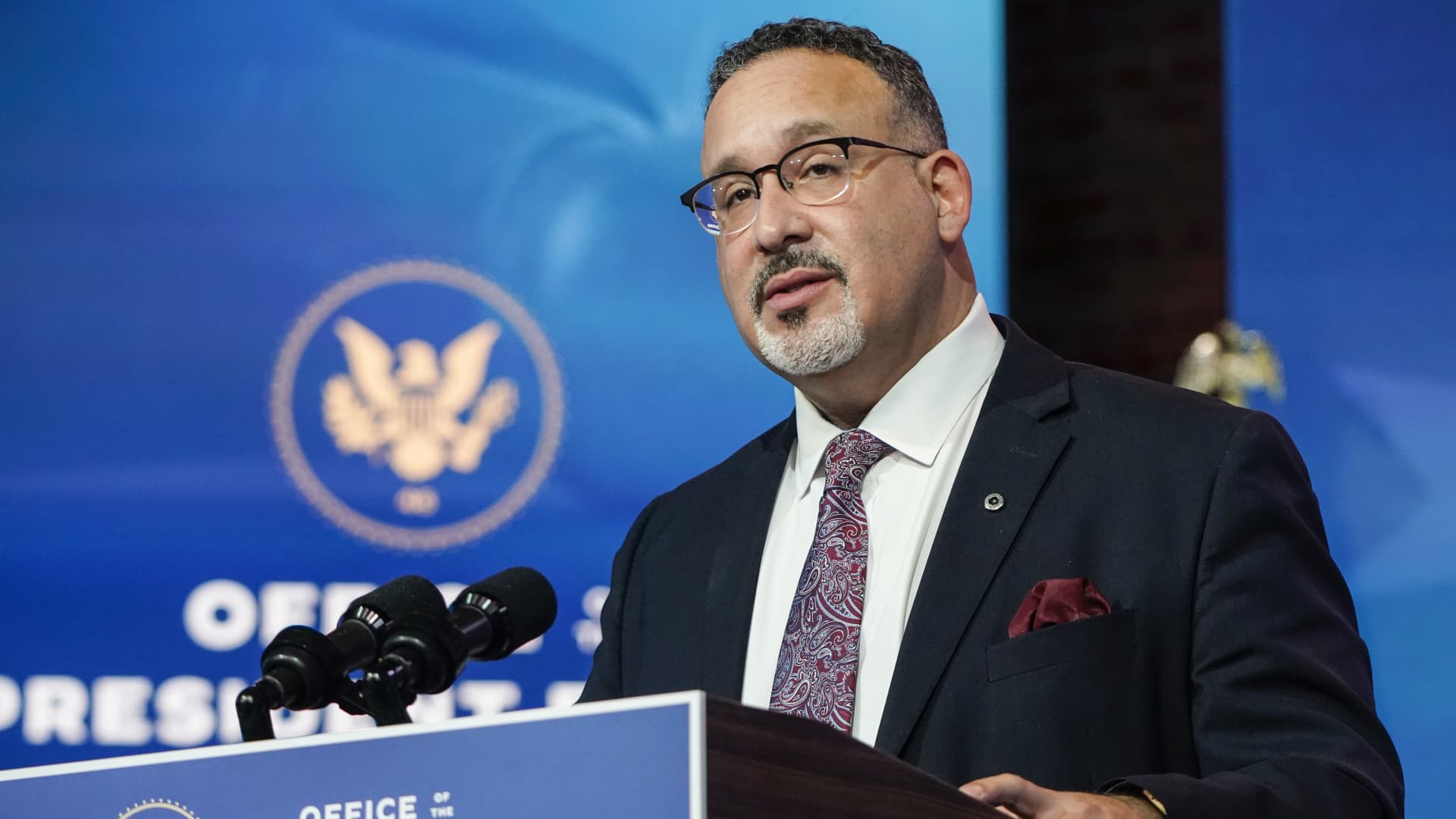
U.S. Instruction Secretary Miguel Cardona delivers remarks at the department’s Lyndon Baines Johnson Creating in Washington, D.C., on Jan. 27, 2022.

Chip Somodevilla | Getty Photographs

Short term alterations to the troubled Public Support Mortgage Forgiveness System have resulted in extra than 110,000 people with scholar debt receiving all-around $6.8 billion in reduction.

The new figures from the U.S. Division of Training display how several borrowers are benefiting from the plan fixes declared by the Biden administration past yr. Hundreds of thousands much more could however see their credit card debt discharged as section of the energy. The ordinary sum of credit card debt reduction per borrower is shut to $60,000, in accordance to the Education and learning Office.

The community company bank loan forgiveness was signed into regulation by then-President George W. Bush in 2007, and lets nonprofit and federal government staff members to have their federal pupil financial loans canceled immediately after 10 yrs, or 120 payments. The Buyer Money Security Bureau estimates that a person-quarter of American personnel could be eligible.

Much more from Own Finance:
How taxes on wages for Social Safety could adjust

Seniors have large hopes for prescription drug pricing reform
How changing do the job requirements might help SSI beneficiaries

However, the method has been plagued by issues, producing men and women who basically get the reduction a rarity.

Debtors generally feel they’re having to pay their way to financial loan cancellation only to discover at some issue in the process that they never qualify, commonly for bewildering technological reasons. Lenders have been blamed for misleading debtors and botching their timelines.

The reforms below the Biden administration contain reassessing borrowers’ timelines and counting some payments that have been previously ineligible due to the fact, say, a borrower was unwittingly in a nonqualifying compensation program.

How can I reward from the new regulations?

To begin, you want to act promptly, claimed Mark Kantrowitz, a increased instruction qualified.

That is for the reason that the Biden administration’s new policies for community service bank loan forgiveness are slated to expire on Oct. 31.

If you have either a Federal Family members Schooling Loan (FFEL) or a Federal Perkins Financial loan, which do not typically depend for public assistance financial loan forgiveness but now temporarily do, you will need to have to consolidate those into direct loans with your servicer.

“It usually takes 30 times to 45 times for the consolidation to manifest,” Kantrowitz said.

“Borrowers should do this even if they really don’t count on to have 120 payments by the deadline, as the previously ineligible payments will depend only if they do this,” he additional.

In addition, borrowers will also have to confirm that their function was deemed public provider for any stretch of time that they are striving to get counted toward forgiveness. To do so, you are going to want to file with your servicer a so-called employer certification sort for each and every job you have had all over your timeline.

Borrowers at present jobless or not operating in general public service might even now qualify for forgiveness now, so extensive as they’ve designed 120 qualifying payments in the earlier, Kantrowitz additional.

Also, continue to keep in thoughts that months throughout the government’s payment pause and curiosity waiver on federal college student financial loans, which has been in result since March 2020, depend towards the program, even if you haven’t been spending.

Some debtors look to be receiving forgiveness immediately just after the government’s auditing of these accounts.

Nevertheless, having these methods will make certain you profit.

A full recap of the Fed’s rate hike and big market rally

A full recap of the Fed’s rate hike and big market rally

Gary Cohn says Powell gave the market the policy transparency it wanted

Former Goldman Sachs President Gary Cohn told CNBC he thinks Fed Chair Jerome Powell “drove it right down the middle of the road” during his news conference, perfectly meeting the market’s expectations as evidenced by the relief rally in stocks. 

In particular, Cohn said the market appreciated Powell’s clear communication around the Fed’s approach to quantitative tightening. “The market has been trained to have transparency, and we got transparency,” said Cohn, who also led the National Economic Council under former President Donald Trump.

He added that he believes Powell laid the roadmap for two more 50 basis point interest rate hikes at upcoming meetings.

— Kevin Stankiewicz

Stocks rally broadly after Powell comments, financials and tech jump

U.S. stocks rallied across the board Wednesday after Fed Chair Powell in the press conference ruled out larger rate hikes and emphasized the possibility of a soft landing — tamping down inflation without inducing a recession.

All 11 S&P 500 sectors were positive on the day in the last hour of trading.

Stocks leveraged to an improving economy were among the biggest winners. Energy was the top-performing sector. Financial names were also a leading group, with names like Bank of America and Wells Fargo jumping roughly 4{ac23b82de22bd478cde2a3afa9e55fd5f696f5668b46466ac4c8be2ee1b69550}.

Technology stocks, which have been under pressure, also climbed. Communication services and information tech were among the top S&P 500 sectors. The moves came as the benchmark 10-year Treasury yield dipped. Apple rose more than 3{ac23b82de22bd478cde2a3afa9e55fd5f696f5668b46466ac4c8be2ee1b69550}, and Meta Platforms gained roughly 5{ac23b82de22bd478cde2a3afa9e55fd5f696f5668b46466ac4c8be2ee1b69550}.

—Hannah Miao

Market is applauding Powell’s comments, LPL’s Krosby says

The major averages were up sharply heading into the close, with the Dow up 900 points.

“The market is applauding Chairman Powell’s comments that the economy remains strong thanks to solid corporate balance sheets and still cash-rich consumers,: said Quincy Krosby, chief equity strategist at LPL Financial. “Moreover, he suggested that perhaps the worst of the sharp move in inflationary pressures may be poised to ease.”

“Still, Powell underscored that while the FOMC remains data dependent for each meeting, the market can expect 50 basis point hikes at the next two meetings. He made it clear that corralling inflationary pressures is crucial,” Krosby added.

—Fred Imbert

Powell news conference wraps up

Federal Reserve Chairman Jerome Powell has concluded an eventful news conference, which saw the major U.S. stock benchmarks rally on remarks that the Fed would not raise rates by 75 basis points.

—Fred Imbert

Federal Reserve will restore stable pricing as ‘quickly and effectively’ as it can, Powell says

Chairman Jerome Powell believes the Federal Reserve has a “good chance” of restoring stable prices without causing a strong increase in unemployment.

“We need to do everything we can to restore stable prices as quickly and effectively as we can,” Powell said. “We think we have a good chance to do it without a significant increase in unemployment or a really sharp slowdown.” 

While the move may not be “pleasant” and requires higher rates in the short-term, everyone will benefit in the long run, Powell said. Those on fixed income or lower end of income distribution particularly benefit from stable prices, he added.

“We think about the medium and longer-term and everyone will be better off if we can get this job done,” he said. “The sooner the better.”

— Samantha Subin

Powell’s comments on rates, economy soothed investors and triggered rally

State Street Global Advisors chief investment strategist Michael Arone said the Federal Reserve delivered on its guidance and eased investors’ concerns about the path of its rate hiking.

He said Fed Chairman Jerome Powell soothed markets with his comments, including when he said a 75 basis point hike was not currently under consideration. The Fed raised interest rates by a half percent Wednesday afternoon, the biggest hike since the year 2000.

“I think there’s three things” in Powell’s comments, Arone said. “They’re not actively considering 75 basis points. There’s some evidence that inflation may have peaked. And thirdly, he acknowledged it won’t be easy but he thinks a soft landing is still possible because households, businesses and the labor markets remain in good shape.”

The chairman also said the Fed could consider 50 basis point hikes at the next couple of meetings, and Arone said it was a positive that Powell limited the half point hikes to two meetings.

The major averages were up sharply at around 3:15 p.m. ET, with the Dow up more than 700 points. The S&P 500 and Nasdaq are up more than 2{ac23b82de22bd478cde2a3afa9e55fd5f696f5668b46466ac4c8be2ee1b69550} each.

—Patti Domm

Strategist breaks down why stocks are rallying

Adam Crisafulli, founder of Vital Knowledge, broke down why stocks rallied during Powell’s press conference.

“Stocks were excited about Powell refuting talk of 75bp increases and his (very modest) optimism about recent PCE trends, but his rhetoric about combating price increases was even more forceful than before,” Crisafulli said.

— Yun Li

Powell says Fed policies are ‘famously blunt tools’

Fed Chair Jerome Powell said the central bank has a “good chance” to curb inflation without inducing a recession, but noted challenges in that endeavor.

“We don’t have precision surgical tools. We have essentially interest rates, the balance sheet and forward guidance and they’re … famously blunt tools,” Powell said at the press conference.

“No one thinks this will be easy. No one thinks it’s straightforward. But there’s certainly a plausible path to this,” he added.

—Hannah Miao

Traders reduced bets for rate hikes this year

Traders are reducing thier expectations for Federal Reserve rate hikes this year.

Traders had been expecting a possible 75 basis point rate hike in June, but Fed Chairman Jerome Powell said that is not currently under consideration. The chairman also said the Fed could consider 50 basis point hikes at the next couple of meetings.

According to Wells Fargo’s Michael Schumacher, fed funds futures were pricing in 52 basis points of hiking in June after Powell’s comment, down from 61 basis points before the 2 p.m. ET Fed statement.

The futures market also shows traders reduced expectations for rate hikes this year. The futures market is now pricing in a fed funds rate of 2.80{ac23b82de22bd478cde2a3afa9e55fd5f696f5668b46466ac4c8be2ee1b69550} at the end of the year, down from 2.96{ac23b82de22bd478cde2a3afa9e55fd5f696f5668b46466ac4c8be2ee1b69550} before the Fed’s statement.

The Fed announced it was raising the fed funds rate by a half percentage point and said it “remains highly attentive to inflation risks.”

—Patti Domm

Powell emphasizes Fed policy works on demand, not supply

Fed Chair Jerome Powell reiterated the central bank’s policy fights inflation through curbing demand, and cannot address supply side issues.

“Our tools don’t really work on supply shocks, our tools work on demand,” Powell said at the post-policy meeting press conference.

The Fed chair also highlighted the war in Ukraine and Covid case surges in China as two geopolitical issues that could further exacerbate global supply chain disruptions.

“For both the situation in Ukraine and the situation in China, they’re likely to both add to headline inflation,” Powell said. “They’re both capable of preventing further progress in supply chains … or even making supply chains temporarily worse.”

—Hannah Miao

Powell says he’s not ‘actively considering’ 75 basis point increase

Federal Reserve Chairman Jerome Powell said the central bank is not “actively considering” a 75 basis point increase.

“So a 75 basis point increase is not something that committee is actively considering,” Powell said. “I think expectations are that we’ll start to see inflation, you know, flattening out.”

“It’s a very difficult environment to try to give forward guidance 60, 90 days in advance, there’s just so many things that can happen in the economy around the world. So, you know, we’re leaving ourselves room to look at the data and make this decision as we get there.”

— Sarah Min

Powell: The labor market is ‘extremely tight’

“The labor market has continued to strengthen and is extremely tight,” according to Federal Reserve Chairman Jerome Powell.

The chairman noted that labor supply remains subdued even as labor demand gains strength. Employment rose by 1.7 million jobs over the first three months of the year, and the unemployment rate has dropped to a near five-decade low of 3.6{ac23b82de22bd478cde2a3afa9e55fd5f696f5668b46466ac4c8be2ee1b69550}, according to the Fed chair.

The result is employers are having difficulties filling job openings and wages are rising at the fastest pace in many years, Powell said.

— Sarah Min

Powell sees ‘good chance’ of a soft-landing for economy

Federal Reserve Chairman Jerome Powell said the central bank has a “good chance” of achieving a soft landing for the U.S. economy as it hikes rates to combat rising inflation.

“I would say I think we have a good chance to have a soft or softish landing, or outcome if you will,” Powell said.

While maintaining a soft landing will be a challenge, Powell pointed to the resilient labor market, noting that households and businesses remain in “strong financial shape.”

“It doesn’t seem to be anywhere close to a downturn,” Powell said. “Therefore, the economy is strong and is well-positioned to handle tighter monetary policy.”

—Samantha Subin

Major averages rally after Powell rules out 75 basis point hike

The Dow, S&P 500 and Nasdaq jumped to their highs of the day after Fed Chairman Jerome Powell said the central bank wasn’t considering a 75 basis point rate hike.

The Dow was up more than 400 points, or 1.5{ac23b82de22bd478cde2a3afa9e55fd5f696f5668b46466ac4c8be2ee1b69550}. The S&P 500 traded 1.4{ac23b82de22bd478cde2a3afa9e55fd5f696f5668b46466ac4c8be2ee1b69550} higher, and the Nasdaq advanced 1.2{ac23b82de22bd478cde2a3afa9e55fd5f696f5668b46466ac4c8be2ee1b69550}.

—Fred Imbert

Powell says half point increases at next FOMC meetings are on the table

Fed Chairman Jerome Powell said Wednesday that, with the labor market being “extremely tight” and inflation “much too high,” the Federal Open Market Committee could continue to raise the Fed Funds rate over the next few months.

“We are on a path to move our policy rate expeditiously to more normal levels,” he said. “Assuming that economic and financial conditions evolve in line with expectations, there is a broad sense on the committee that additional 50 basis point increases should be on the table at the next couple of meetings.”

He added that the committee also decided to begin the process of reducing its balance sheet, which will play an important role in forming the stance of monetary policy.

— Tanaya Macheel

Powell: Fed is ‘moving expeditiously’ to bring down inflation

The Fed is “moving expeditiously” to combat rising inflation which has hard-hit consumers, said Chairman Jerome Powell to start the central bank’s post-announcement news conference.

“Inflation is much too high and we understand the hardship it is causing, and we are moving expeditiously to bring it back down,” he said. “We have both the tools we need and the resolve it will take to restore price stability on behalf of American families and businesses.”

Powell added that the economy and country have “proved resilient” as they fight the conditions over the past two years and said that bringing down inflation is crucial to creating a “sustained period” of strong labor market conditions.

—Samantha Subin

Oil’s surge adds to inflationary pressures

Federal Reserve Chairman Jerome Powell pointed to the rapid rise in commodity prices, prompted by Russia’s war, as adding to inflationary pressures across the economy.

“The surge in prices of crude oil and other commodities that resulted from Russia’s invasion of Ukraine is creating additional upward pressure on inflation,” he said Wednesday.

West Texas Intermediate crude futures, the U.S. oil benchmark, traded around $107.51 per barrel Wednesday. The contract is up more than 40{ac23b82de22bd478cde2a3afa9e55fd5f696f5668b46466ac4c8be2ee1b69550} this year, which has sent gas prices at the pump to record highs.

— Pippa Stevens

Dow briefly erases gains as Powell kicks off news conference

The Dow Jones Industrial Average briefly turned negative on the day as Fed Chairman Jerome Powell started his news conference.

The 30-stock average was last up 64 points, or 0.2{ac23b82de22bd478cde2a3afa9e55fd5f696f5668b46466ac4c8be2ee1b69550}. The S&P 500 hovered around the flatline, while the Nasdaq Composite was down 0.5{ac23b82de22bd478cde2a3afa9e55fd5f696f5668b46466ac4c8be2ee1b69550} as of 2:36 p.m. ET.

—Fred Imbert

Market action shows Fed’s rate hike well telegraphed, strategist says

The Fed just announced its biggest rate increase in two decades, and yet stocks are not selling off.

“It’s certainly heady days when the market doesn’t blink at the most aggressive rate hike in 22 years, but keep in mind this was extremely well-telegraphed and priced in,” said Mike Loewengart, managing director of investment strategy at E-Trade. “So far though, we don’t have much to go on in terms of the pace and magnitude of hikes to come.”

—Yun Li

Market relieved Fed wasn’t more hawkish, State Street’s Arone says

State Street Global Advisors chief investment strategist Michael Arone said the market is breathing a sigh of relief after the Fed’s latest announcement.

“I think right now there’s relief it wasn’t more hawkish,” Arone said, noting the Fed is also pushing the idea that it will keep raising rates.

“I think one of the things that was most interesting was that the Fed decided to shift the description of transitory from inflation to the economy,” he added. “They acknowledged the weakness in the economy, but their language suggested this was temporary and household spending and business spending remains strong. I thought that was an interesting way for them to support the need for more rate hikes.”

—Patti Domm

Dow and S&P 500 rise to session highs after rate hike

The Dow and S&P 500 rose to their highs of the day shortly after the Fed announced its latest decision on monetary policy.

At one point, the Dow was up as much as 255.77 points, or 0.8{ac23b82de22bd478cde2a3afa9e55fd5f696f5668b46466ac4c8be2ee1b69550}. The S&P 500 was briefly up 0.86{ac23b82de22bd478cde2a3afa9e55fd5f696f5668b46466ac4c8be2ee1b69550}. Both benchmarks have since eased from those levels, but remain higher on the day.

—Fred Imbert

What changed in the Fed statement

Key changes to the statement include from the March 16 meeting include the central bank noting that “COVID-related lockdowns in China are likely to exacerbate supply chain disruptions. The Committee is highly attentive to inflation risks.”

Click here to see what else has changed in the statement.

—Fred Imbert, Hannah Miao

Fed raises rates by 50 basis points, biggest hike in 2 decades

The Fed raised rates by 50 basis points, marking the central bank’s biggest rate hike since 2000.

Wednesday’s statement noted that economic activity “edged down in the first quarter” but noted that “household spending and business fixed investment remained strong.” Inflation “remains elevated,” the statement said.

The Fed also said it will begin reducing its massive $9 trillion balance sheet on June 1.

—Fred Imbert

Trading strategies for the post-Fed market

Citi says stocks have further to fall before the Fed rethinks rate hikes

Historically, the market could count on the Fed to step in with easy policy to help limit big losses in equities. But with inflation running at 40-year highs, Citi analysts say the central bank could wait longer to take its foot off the breaks.

Data suggest the Fed could wait for the S&P 500 to sink to the 3,800 level, or 9{ac23b82de22bd478cde2a3afa9e55fd5f696f5668b46466ac4c8be2ee1b69550} below Tuesday’s close.

“High inflation constrains the Fed, making easing monetary policy less likely if growth (or markets) fall,” Citi analyst Alexander Saunders said Wednesday. “We have long argued that elevated inflation would put the Fed in a bind — when growth weakens they would not be willing to or able to ride to the rescue by loosening monetary policy.”

— Tanaya Macheel

History shows these stocks beat the market as short-term rates climb

Short-term interest rates are on a tear this year, with the 2-year Treasury yield nearly quadrupling in 2022. With the Federal Reserve expected to hike the benchmark fed funds rate again in its May meeting, CNBC Pro screened for stocks that have outperformed during previous periods of rising short-term rates. Take a look at our list on CNBC Pro.

One name to emerge from our historical analysis is financial services firm Charles Schwab. The company benefits from rising rates in a number of ways. For example, the firm reinvests its customer balances at higher yields, while the rate it pays on those balances lags behind, widening the net interest margin. Sure enough, Schwab shares are up more than 5{ac23b82de22bd478cde2a3afa9e55fd5f696f5668b46466ac4c8be2ee1b69550} this week ahead of the Fed meeting statement release and press conference.

—Hannah Miao

Stocks, bonds struggle since first hike

The first Fed hike in March didn’t do much to calm markets.

Stocks initially rallied after the March Fed meeting, with the S&P 500 gaining more than 6{ac23b82de22bd478cde2a3afa9e55fd5f696f5668b46466ac4c8be2ee1b69550} in the back half of the month. However, after a rough April, the broad market index has hit new lows for the year. The Nasdaq Composite has had an even rougher time and is down nearly 20{ac23b82de22bd478cde2a3afa9e55fd5f696f5668b46466ac4c8be2ee1b69550} for the year.

The sell-off in bonds has been even more dramatic. The 10-year Treasury yield was at 2.16{ac23b82de22bd478cde2a3afa9e55fd5f696f5668b46466ac4c8be2ee1b69550} on March 15, the day before the first hike. That benchmark yield has traded above 3{ac23b82de22bd478cde2a3afa9e55fd5f696f5668b46466ac4c8be2ee1b69550} several times this week.

— Jesse Pound

The case for a post-Fed relief rally

The market is so ready for the Federal Reserve’s big rate hike later on Wednesday that it could see a relief rally once it has passed.

DataTrek’s Nicholas Colas noted that the market’s set-up heading into the Fed decision “is a near carbon copy” of the last two meetings. After those meetings, the S&P 500 rallied between 5.2{ac23b82de22bd478cde2a3afa9e55fd5f696f5668b46466ac4c8be2ee1b69550} and 6.3{ac23b82de22bd478cde2a3afa9e55fd5f696f5668b46466ac4c8be2ee1b69550} in the following one to two weeks, Colas said.

BlackRock’s Rick Rieder has also noted that the Fed could spark a relief rally, adding that the recent market sell-off could be nearing its end.

Stocks are coming off a horrible April, with the S&P 500 falling more than 8{ac23b82de22bd478cde2a3afa9e55fd5f696f5668b46466ac4c8be2ee1b69550} for its biggest monthly decline since March 2020.

—Fred Imbert

50 basis point rate hike expected

The consensus on Wall Street is for the Federal Reserve to raise rates by 50 basis points Wednesday. However, some investors still worry that Fed Chairman Jerome Powell could signal an even more aggressive monetary policy stance, as the central bank tries to stave off the strongest inflationary pressures seen in decades.

“I think they’re going 50 [basis points], and it seems like they’re dead set on hiking rates enough to kill inflation,” Jim Caron, chief fixed income strategist on the global fixed income team at Morgan Stanley Investment Management, told CNBC earlier this week. “But that’s the real debate. Are they trying to get to target inflation by 2024? If they are, the wage inflation is pretty high and that will require even more tightening than the Fed is projecting.”

—Fred Imbert, Patti Domm