
Poll Finds Overwhelming Positive Support; Civics Education Also Important to Residents
Vermont Business Magazine More than nine out of 10 Vermont residents believe that personal finance education is an important subject that should be taught in high school. This overwhelming finding emerged from a statewide poll of 541 voters conducted this month by Public Policy Polling for the Center for Financial Literacy at Champlain College.
John Pelletier, director of the center, notes that the poll shows 93 percent of Vermont residents agree that a personal finance course should be offered in high school. Pelletier also notes that 88 percent of Vermont adults believe that guaranteed access to a personal finance course for all Vermont high school students is urgently needed. Yet, despite these views, currently, few Vermont high school students have guaranteed access in high school to a full-semester course in personal finance prior to graduation.
See results below.
Pelletier believes that this poll data will help state education policy makers, legislators, the state board of education and the agency of education make informed decisions regarding personal finance education in Vermont’s public schools.
“Personal finance education changes behaviors in positive ways,” says Pelletier. “Research demonstrates that high school students with this knowledge improve their own money management practices, and share this learning with their families, resulting in improved parent knowledge, saving and spending behaviors.”
He also notes that individual financial literacy means healthier family balance sheets, which in turn builds a stronger state economy. And studies like this one show employees who are money savvy are happier with and remain longer in their jobs.
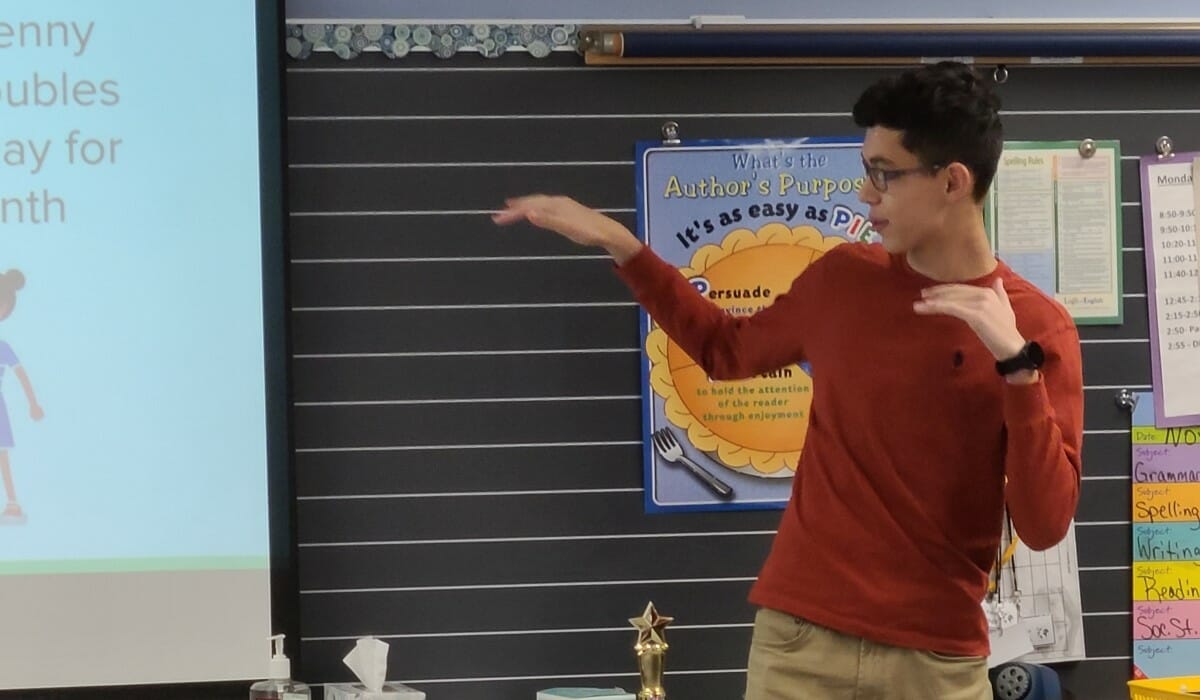
Courtney Poquette, who teaches personal finance at Winooski High School, says she and her students believe it is the most important course in high school in 2023. “It’s the one course Vermont students will take in high school that they will use every day for the rest of their lives.” Her former student David Klinker, now a student at Champlain College, agrees, and wrote a commentary piece in VT Digger outlining how the course completely changed his life.
Pelletier says that there is a national movement to bring the subject to more high schools, since just 1 in 4 students nationwide currently have access to a guaranteed course.
Personal finance is also an issue of equity, says Pelletier. He points to this 2022 study by Next Gen Personal Finance, which shows that in states that do not guarantee access to personal finance education those who arguably need this training the most are the least likely to receive it. In these states, which includes Vermont, wealthy and less diverse high schools are approximately three times more likely to guaranteed access to this training than very poor and very diverse high schools in our nation.
On the positive side, he notes that last year, six more states passed legislation guaranteeing a personal finance course, bringing the total number of states with such guarantees to 17. He also notes that it is expected that a dozen more states will consider this change in 2023, Vermont being among them.
In the state poll, 87 percent of respondents indicated that high school personal finance education was very important and 12 percent said it was somewhat important. Ninety-three percent of respondents said a course covering budgeting, investing, taxes and saving should be offered in high school, while 83 percent felt the course should be guaranteed for all students.
Informed that just 12 percent of high school students in Vermont were guaranteed a personal finance course, 88 percent of poll respondents said a law requiring such a course is an urgent issue. Currently in Vermont, only Black River, Lamoille, Milton, Missisquoi, Spaulding, Vergennes and Winooski high schools provide student with guaranteed access to personal finance in high school. BFA St. Albans plans on joining this list of guaranteed access high schools.
A bill calling for a course in civics was introduced in the last session of the Vermont legislature, so the poll also included questions on this issue. Eighty four percent of respondents believe a course in civics—covering the Constitution and matters related to the U.S. government—is very important, and 92 percent indicated that such a course should be taught. Eighty-five percent of respondents believe civics should be a guaranteed course.
Pelletier notes that personal finance education doesn’t stop in high school. A 2019 U.S. Treasury Department report on financial literacy best practices for colleges included the recommendation that colleges “should require mandatory courses to teach students financial concepts and skills.”
Champlain College is one of the few colleges that requires its on-campus undergraduate students to take personal finance training as a graduation requirement. The college’s InSight Program teaches students fundamental personal finance skills including how to negotiate your salary (including benefits and evaluation of compensation packages), create and follow a budget, establish credit, manage debt, invest your money, and more.
“Champlain equips its students with the life skills needed to complement academic and career success,” said Olivia Vittitow, the InSight Program Manager. “Embedding four years of financial, personal, and wellbeing-focused workshops, seminars, and one-on-one coaching as a part of our undergraduate requirements has resulted in Champlain graduates avoiding student loan default issues and enjoying financial stability after graduation.”
Evidence that Financial Education Improves Behavioral Outcomes
Evidence-Based Policy & Implementation Resources
Evidence that Financial Education Improves Behavioral Outcomes
a) The Effects of K-12 Financial Education Mandates on Student Postsecondary Education Outcomes
Research from the National Endowment for Financial Education. Financial education mandates have positive impacts on student borrowing behaviors across all income groups. States with personal finance graduation requirements have students with a higher incidence of applying for financial aid, a lower incidence of borrowing from private student lenders, a higher incidence of receiving grants and federal aid, and a lower likelihood of carrying credit card balances.
b) Does Financial Education Impact Financial Literacy and Financial Behavior, and If So, When?
Most earlier studies of financial education rely on outdated financial education requirements. Kaiser and Menkhoff show significant positive effects of financial education on both financial literacy (knowledge) and financial behavior. This meta-analysis corrects an often cited meta-analysis from Fernandes et. al. (2014), adding additional interventions and a more rigorous statistical methodology to make its conclusions. Compelling, rigorously critiqued evidence of the need for “just in time” financial education for high school students.
c) Financial Education Matters: Testing the Effectiveness of Financial Education Across 76 Randomized Experiments
We study the rapidly growing literature on the causal effects of financial education programs in a meta-analysis of 76 randomized experiments with a total sample size of over 160,000 individuals. The evidence shows that financial education programs have, on average, positive causal treatment effects on financial knowledge and downstream financial behaviors. Treatment effects are economically meaningful in size, similar to those realized by educational interventions in other domains, and are at least three times as large as the average effect documented in earlier work. These results are robust to the method used, restricting the sample to papers published in top economics journals, including only studies with adequate power, and accounting for publication selection bias in the literature. We conclude with a discussion of the cost-effectiveness of financial education interventions.
d) Does State-Mandated Financial Education Affect High-Cost Borrowing? (UPDATED 2019)
“…young adults who were required to take personal finance courses in high school were significantly less
likely to borrow payday loans than their peers who were not. These effects do not significantly differ by race/ethnicity or gender, suggesting that financial education may be useful regardless of demographics.”
e) Retirement Savings with School-Based Financial Education
Students’ financial literacy performance is significantly associated with their schools’ and teachers’ characteristics, both positive and negative. Students who attend a school with adequate teaching materials and competent teachers — those who demonstrate control over their classroom and try to actively engage with students — are more likely to perform at the two highest levels on the PISA financial literacy test.
f) Optimal Financial Knowledge and Wealth Inequality
Financial literacy plays a key role in explaining inequality. Different levels of financial knowledge early in life have important implications for how much people will save. Adding financial knowledge to life cycle models permits a more accurate rendering of a world where consumers must cope with complex financial markets and must save so as to provide for their own retirement.
g) The impact of high school financial education: experimental evidence from Brazil
This paper studies the impact of a comprehensive financial education program spanning six states, 868 schools, and approximately 20,000 high school students in Brazil through a randomized control trial. The program increased student financial knowledge, increased saving rates for purchases, better likelihood of financial planning, and greater participation in household financial decisions by students. “Trickle-up” impacts on parents were also significant, with improvements in parent financial knowledge, savings, and spending behavior. The study also finds evidence that the program affected students’ inter-temporal preferences and attitudes.
h) Personal Finance Education Mandates & Student Loan Repayment
“Students with higher-income parents respond by adjusting borrowing, reducing median balances by 7{ac23b82de22bd478cde2a3afa9e55fd5f696f5668b46466ac4c8be2ee1b69550}. By contrast, first-generation and low-income borrowers bound by mandates did not significantly adjust borrowing, but were nonetheless more likely to pay down balances..”
i) Can financial literacy reduce domestic violence?
“Yes. Using data on more than 3.7 million intimate partner violence (IPV) incidents between 1994 and 2016, and exploiting the staggered introduction of state-mandated personal finance high school graduation requirements across U.S. states for identification, we show that improvements in women’s financial literacy can significantly reduce the rates of violence against women perpetrated by their male partners. We conservatively estimate a reduction in violence by between 3{ac23b82de22bd478cde2a3afa9e55fd5f696f5668b46466ac4c8be2ee1b69550} and 11{ac23b82de22bd478cde2a3afa9e55fd5f696f5668b46466ac4c8be2ee1b69550}. Our evidence points to financial literacy deterring financial abuse, thereby empowering women to leave abusive relationships earlier or by preventing the first incident from ever occurring.”
Evidence-Based Policy & Implementation Resources
a) Transforming the Financial Lives of a Generation of Young Americans POLICY RECOMMENDATIONS FOR ADVANCING K-12 FINANCIAL EDUCATION
What we propose here is a comprehensive strategy to impart personal financial management skills to young people while they are in school. Recommendation 1: Introduce key financial education concepts early and continue to build on that foundation consistently throughout the K-12 school years. In addition, CFPB encourages states to make a stand-alone financial education course a graduation requirement for high school students. Recommendation 2: Include personal financial management questions in standardized tests. Recommendation 3: Provide opportunities throughout the K-12 years to practice money management through innovative, hands-on learning opportunities. Recommendation 4: Create consistent opportunities and incentives for teachers to take financial education training with the express intention of teaching financial management to their students
Consumer Financial Protection Bureau. (2013). Transforming the Financial Lives of a Generation of Young Americans POLICY RECOMMENDATIONS FOR ADVANCING K-12 FINANCIAL EDUCATION. [online] consumerfinance.gov. Available at: http://files.consumerfinance.gov/f/201304_cfpb_OFE-Policy-White-Paper-Final.pdf
b) Final Report – President’s Advisory Council on Financial Capability
The Council acknowledges that financial capability must be woven into the fabric of our lives—into our homes, our schools, our workplaces, our communities, even the design and regulation of the financial products and services we use.
United States Treasury. (2013). Final Report President’s Advisory Council on Financial Capability. [online] treasury.gov. Available at: https://www.treasury.gov/resource-center/financial-education/Documents/PACFC{ac23b82de22bd478cde2a3afa9e55fd5f696f5668b46466ac4c8be2ee1b69550}20final{ac23b82de22bd478cde2a3afa9e55fd5f696f5668b46466ac4c8be2ee1b69550}20report{ac23b82de22bd478cde2a3afa9e55fd5f696f5668b46466ac4c8be2ee1b69550}20revised{ac23b82de22bd478cde2a3afa9e55fd5f696f5668b46466ac4c8be2ee1b69550}2022513{ac23b82de22bd478cde2a3afa9e55fd5f696f5668b46466ac4c8be2ee1b69550}20{ac23b82de22bd478cde2a3afa9e55fd5f696f5668b46466ac4c8be2ee1b69550}288{ac23b82de22bd478cde2a3afa9e55fd5f696f5668b46466ac4c8be2ee1b69550}29_R.pdf
c) Financial Capabilities of College Students from States with Varying Financial Education Policies
Well-educated students exhibit positive financial behaviors. After analyzing data from 15,797 college students, Gutter found that students from states where a financial education course was required had the highest reported financial knowledge and were more likely to display positive financial behaviors and dispositions. Compared to other students, these young adults were: More likely to save; Less likely to max out their credit cards; Less likely to make late credit card payments; More likely to pay off credit cards in full each month; Less likely to be compulsive buyers; More likely to be willing to take average financial risk
d) Financial Education in High Schools Across America
State-level embedded course requirement mandates do not result in full compliance. While this lack of compliance could be because course catalog descriptions do not detail financial literacy instruction in all schools, it could also be because state departments of education have trouble auditing embedded course mandates. In our estimate, only 43{ac23b82de22bd478cde2a3afa9e55fd5f696f5668b46466ac4c8be2ee1b69550} within states that have embedded course mandates have either a standalone or embedded course requirement.
e) Financial Literacy Subject Survey
Between July 15th and 17th, 2017 the National Financial Educators Council asked 5,123 young adults, “What high school-level course would benefit your life the most?” Respondents chose money management more often than math, science, and social studies:
- 49.97{ac23b82de22bd478cde2a3afa9e55fd5f696f5668b46466ac4c8be2ee1b69550} selected “Money Management (Personal Finance)”
- 18.25{ac23b82de22bd478cde2a3afa9e55fd5f696f5668b46466ac4c8be2ee1b69550} selected “Mathematics (Algebra, Geometry)”
- 14.43{ac23b82de22bd478cde2a3afa9e55fd5f696f5668b46466ac4c8be2ee1b69550} selected “Social Studies (History, Government)”
- 17.35{ac23b82de22bd478cde2a3afa9e55fd5f696f5668b46466ac4c8be2ee1b69550} selected “Science (Biology, Chemistry)”
State by state results are available: NFEC Survey: “Should High Schools Require Financial Literacy?”
NFEC. (2017). Financial Literacy Subject Survey. [online] Available at: https://www.financialeducatorscouncil.org/Financial-literacy-subject-survey/
f) A review of youth financial education: Effects and Evidence
“This report reviews current research and reporting in the field, and is intended to inform policymakers, practitioners, financial educators, and researchers of the current state of rigorous evidence on financial education in schools”… “This report features studies that (1) evaluate youth financial education programs in schools, (2) have a causal interpretation evidenced by a randomized controlled trial, natural experiment setting, or a valid pre-post study design, and (3) have been published in peer-reviewed academic journals or as reviewed working papers. Note that the studies predominantly relate to school based programs, as this is the context in which most youth financial education research has occurred.”
- “Well-implemented state financial education mandates led to a clear improvement in financial behaviors.”
- “Many U.S. financial education programs improve financial knowledge for students, though effect sizes vary based on the population served, amount of instruction time, and topics covered.”
- “Other countries have used more widespread randomized controlled trials to study the effects of programs as they embed and expand them broadly. Those studies also provide useful information.”
- Consumer Financial Protection Bureau. (2019). A review of youth financial education: Effects and Evidence. [online] consumerfinance.gov. Available at: https://files.consumerfinance.gov/f/documents/cfpb_youth-financial-education_lit-review.pdf
g) Digital vs. in-person financial education: What works best for Generation Z?
“Nowadays, financial literacy is one of the most important skills that can be acquired by a tech-savvy Generation Z student. In order to understand what format of financial education works best for Generation Z, we set up an experiment that involved implementing a financial education program called “Futuro Sicuro” with a sample of 650 High School students in Italy. The program allowed us to gather data from two treatments at the class level, namely 1) a traditional financial education simplified program with the presence of a financial advisor, and 2) a digital financial education program using web-based applications based on learning-by-playing concepts. The two treatments were associated with different costs but showed similar effects: three weeks after their conclusion, we find that both courses did increase actual financial knowledge and the results also aligned with participants’ realistic assessments of their own financial skills. A follow-up study also reveals the persistence of these effects three months later for the traditional course.”
h) Best Practices Implementing Financial Education in High Schools
“…breaks the implementation into eight stages: (0) building a coalition, (1) crafting and passing either legislation or administrative rule change, (2) constructing an implementation plan, (3) funding, (4) teacher professional development, (5) developing standards and selecting course resources, (6) teacher endorsement models, and (7) auditing and creating a feedback loop for continuous improvement.”
Urban, Carly (2022). Best Practices Implementing Financial Education in High Schools [online] Available at: https://papers.carlyurban.com/MTBestPracticesReportFINAL.pdf
About the Center for Financial Literacy: Established in 2010, Champlain College’s Center for Financial Literacy (CFL) was designed to promote and develop financial literacy skills among individuals, allowing them to make more sound decisions about spending, credit, debt, investments, and complex financial situations such as buying a home and saving for retirement. The CFL is nationally acclaimed for its efforts to increase the personal finance knowledge of our citizens and has become the credible, go-to source for national media coverage of financial literacy.
About Champlain College: Founded in 1878, Champlain College is a small, not-for-profit, private college in Burlington, Vermont, with additional campuses in Montreal, Canada, and Dublin, Ireland. Champlain offers a traditional undergraduate experience from its beautiful campus overlooking Lake Champlain and a broad portfolio of online degrees and certificates through Champlain College Online. The College is known for its distinctive and innovative approach to career-focused education and its “upside-down” curriculum, which help students be: “Ready for Work. Ready for Life. Ready to Make a Difference.” Champlain ranks in multiple categories of U.S. News and World Report’s “Best Colleges,” including Best Value Schools, Best Colleges in the North, Best Colleges for Veterans, and Top Performers on Social Mobility. Champlain was also listed among The Princeton Review’s “The Best 388 Colleges” in 2023 and was recognized as a 2022. College of Distinction for its “Engagement, Teaching, Community, and Outcomes.” For more information, visit www.champlain.edu.
January 17, 2023, Burlington, VT — Center for Financial Literacy