USD 133.47 Billion Growth Expected in Smart Education Market: by Product (content, software, and hardware), End-user (higher education and K-12 schools), and Geography (APAC, Europe, North America, South America, and MEA)

NEW YORK, Dec. 9, 2021 /PRNewswire/ — Technavio has announced its latest market research report titled Smart Education Market by Product (Content, Software, and Hardware), End-user (higher education and K-12 schools), and Geography (APAC, Europe, North America, South America, and MEA).

Attractive Opportunities in Smart Education Market by Product, End-user, and Geography - Forecast and Analysis 2021-2025

Attractive Opportunities in Smart Education Market by Product, End-user, and Geography – Forecast and Analysis 2021-2025

Grab this latest smart education market report sample from Technavio Right Here!

Educational institutions are increasingly adopting advanced learning methodologies such as smart education to sharpen the employment prospects of students. The global workforce requirement scenario is facing issues of demand and supply gap, as graduate and post-graduate students lack industry-specific skills and hence, require training. As a result, institutions are focusing on imparting industry-related skills to students so that they can be competent as per industry requirements. The increased demand for education technology products can be attributed to the greater emphasis laid on STEM-based education. The demand for training and educating healthcare professionals in a smart education environment is rising due to the increasing demand for specialist healthcare workers such as physiotherapists and nurses. Hence, the scope for training and education of students opting for allied healthcare as their career is immense. As a result, the increasing employment opportunities will drive the growth of the smart education market.

Read the 120-page report with TOC on “Smart Education Market Analysis Report by Product (Content, Software, and Hardware), End-user (higher education and K-12 schools), and Geography (APAC, Europe, North America, South America, and MEA), and the Segment Forecasts,2021-2025″- https://www.technavio.com/report/report/smart-education-market-industry-analysis

The purchase, as well as the maintenance of these devices, takes a toll on the budgets allocated to schools. Institutions providing smart education are facing challenges related to adequate financial support. Although smart education offers several learning benefits, institutions need to take care of the procurement costs and hardware systems such as classroom wearables and projectors that are expensive. The hardware system procurement is also not uniform across countries, as emerging countries lack the required capital to install them. Educational institutions with limited budgets may not be able to invest heavily in the implementation as well as maintenance of smart software solutions such as LMS, thus, limiting the market growth. Such budget constraints will result in the slow adoption of smart education systems in emerging countries, particularly in the APAC and MEA.

Download Free sample Report for Actionable insights on the challenges that will help companies evaluate and develop growth strategies for 2021-2025.

Major Five Smart Education Companies:

  • Adobe Inc.

  • Blackboard Inc.

  • Cisco Systems Inc.

  • D2L Corp.

  • Dell Technologies Inc.

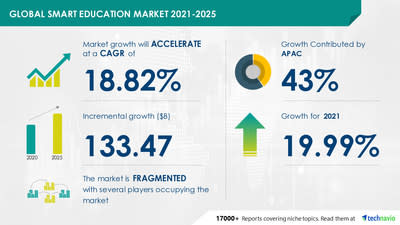
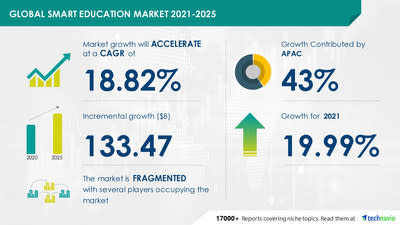
43{ac23b82de22bd478cde2a3afa9e55fd5f696f5668b46466ac4c8be2ee1b69550} of the market’s growth will originate from APAC during the forecast period. China and India are the key markets for smart education in APAC. Market growth in APAC will be faster than the growth of the market in other regions. The education industry in this region, especially India, Japan, and China, is evolving rapidly with regard to the adoption of advanced educational tools and technologies. This will facilitate the smart education market growth in APAC over the forecast period.

Subscribe to our “Lite Plan” billed annually at USD 3000 that enables you to download 3 reports a year and view 3 reports every month.

Smart Education Market Product Outlook (Revenue, USD bn, 2020-2025)

  • Content – size and forecast 2020-2025

  • Software – size and forecast 2020-2025

  • Hardware – size and forecast 2020-2025

Smart Education Market End-user Outlook (Revenue, USD bn, 2020-2025)

Smart Education Market Geography Outlook (Revenue, USD bn, 2020-2025)

  • APAC – size and forecast 2020-2025

  • Europe – size and forecast 2020-2025

  • North America – size and forecast 2020-2025

  • South America – size and forecast 2020-2025

  • MEA – size and forecast 2020-2025

Download this Smart Education Market report to uncover new strategies to make the most of future growth opportunities.

Related Reports on Consumer Discretionary Include:

Education Apps Market by End-user and Geography – Forecast and Analysis 2021-2025

Community College Market in US by Revenue Stream and Course Offerings – Forecast and Analysis 2021-2025

Smart Education Market Scope

Report Coverage

Details

Page number

120

Base year

2020

Forecast period

2021-2025

Growth momentum & CAGR

Accelerate at a CAGR of 18.82{ac23b82de22bd478cde2a3afa9e55fd5f696f5668b46466ac4c8be2ee1b69550}

Market growth 2021-2025

$ 133.47 billion

Market structure

Fragmented

YoY growth ({ac23b82de22bd478cde2a3afa9e55fd5f696f5668b46466ac4c8be2ee1b69550})

19.99

Regional analysis

APAC, Europe, North America, South America, and MEA

Performing market contribution

APAC at 43{ac23b82de22bd478cde2a3afa9e55fd5f696f5668b46466ac4c8be2ee1b69550}

Key consumer countries

US, UK, Germany, China, and India

Competitive landscape

Leading companies, competitive strategies, consumer engagement scope

Companies profiled

Adobe Inc., Blackboard Inc., Cisco Systems Inc., D2L Corp., Dell Technologies Inc., Discovery Education Inc., Ellucian Co. LP, Instructure Inc., Pearson Plc, and Samsung Electronics Co. Ltd.

Market Dynamics

Parent market analysis, Market growth inducers and obstacles, Fast-growing and slow-growing segment analysis, COVID-19 impact and future consumer dynamics, market condition analysis for the forecast period

Customization purview

If our report has not included the data that you are looking for, you can reach out to our analysts and get segments customized.

About Technavio

Technavio is a leading global technology research and advisory company. Their research and analysis focuses on emerging market trends and provides actionable insights to help businesses identify market opportunities and develop effective strategies to optimize their market positions.

With over 500 specialized analysts, Technavio’s report library consists of more than 17,000 reports and counting, covering 800 technologies, spanning across 50 countries. Their client base consists of enterprises of all sizes, including more than 100 Fortune 500 companies. This growing client base relies on Technavio’s comprehensive coverage, extensive research, and actionable market insights to identify opportunities in existing and potential markets and assess their competitive positions within changing market scenarios.

Contacts

Technavio Research
Jesse Maida
Media & Marketing Executive
US: +1 844 364 1100
UK: +44 203 893 3200
Email: media@technavio.com
Website: www.technavio.com/

Technavio (PRNewsfoto/Technavio)

Technavio (PRNewsfoto/Technavio)

Cision

Cision

View original content to download multimedia:https://www.prnewswire.com/news-releases/usd-133-47-billion-growth-expected-in-smart-education-market-by-product-content-software-and-hardware-end-user-higher-education-and-k-12-schools-and-geography-apac-europe-north-america-south-america-and-mea—global-301440291.html

SOURCE Technavio

Minority Students Encouraged to Apply for Dominion Energy Educational Equity Scholarship

– The company will award $500,000 in scholarships to 60 pupils in 2022

– Second calendar year of the six-year, $10 million scholarship method

– Pupils can utilize for scholarships until eventually Jan. 25, 2022

RICHMOND, Va., Dec. 8, 2021 /PRNewswire/ — By means of its Academic Fairness Scholarship Software, Dominion Electricity is awarding $500,000 in scholarships to 60 students in 2022. In its second calendar year of the six-year $10 million initiative, the plan helps with undergraduate increased instruction expenses for underrepresented minority students who reside in the company’s company place.

(PRNewsfoto/Dominion Energy)

(PRNewsfoto/Dominion Vitality)

“We acknowledge the worth of instruction as an equalizer in culture,” explained Robert M. Blue, Dominion Energy’s president and main executive officer. “This system aids minimize the economical hurdle many underrepresented students face, which allows scholarship recipients better accessibility to put up-secondary education and learning and more options to propel their futures.”

The scholarship software interval is open Nov. 30, 2021, through Jan. 25, 2022, 4 p.m. Japanese Regular Time.

To be qualified, college students need to:

  • self-determine as Black or African American Hispanic or Latino American Indian or Alaska Indigenous Asian or Indigenous Hawaiian or other Pacific Islander with higher education and learning fees,

  • be superior university seniors or graduates, or present-day school undergraduates residing in Connecticut, Ohio, West Virginia, Virginia, Maryland, North Carolina, South Carolina, Idaho, Wyoming or Utah, with designs to enroll comprehensive time at an accredited two- or 4-12 months school, university or vocational-technological school for the total approaching academic 12 months and

  • have a minimum grade stage typical of 3. on a 4. scale (or its equivalent).

In all, 60 scholarships totaling $500,000 will be awarded in 2022. Of those people, 20 scholarships of $5,000 each will be created out there for college students enrolled in two-calendar year colleges, although 40 scholarships of $10,000 each and every will be awarded to college students enrolled in 4-yr colleges. Scholarship recipients will be ready to renew scholarships as they progress in school, offered they satisfy sure criteria, this sort of as GPA demands and residence in an suitable condition.

The program is administered by Scholarship America, a nonprofit specializing in taking care of scholarship and tuition aid packages. Scholarship The usa will assist Dominion Vitality in the collection of finalists.

College students can understand extra and apply at DominionEnergy.com/EquityScholarships.

Clinton Washington III, a student at Furman College in South Carolina, was between the 2021 very first class of Dominion Energy Educational Equity Students from eight states in the firm’s services area.

“In early December, everyday living was particularly demanding owing to the affect of COVID-19,” Washington said. “Between obtaining only my mother doing work, and balancing college with economic stress, it was extremely challenging to maintain a content point out of thoughts heading into my spring semester. When I obtained the news regarding the Dominion Strength Instructional Fairness Scholarship, I was so ecstatic simply because I realized it would create an huge amount of reduction for my relatives and myself going into my senior year. This scholarship has definitely improved the trajectory in my mental wellbeing by providing me the liberty to go after all my targets for my senior 12 months. Instead than paying out an huge amount of money of time pursing on campus positions, I can go all in on university, graduate college plans, and my clubs/organizations. The amount of gratitude that I have for this scholarship does not suffice by just terms by yourself, and I actually hope this can be continued for future learners like myself.”

About Dominion Electrical power
About 7 million prospects in 13 states energize their households and enterprises with energy or all-natural gasoline from Dominion Energy (NYSE: D), headquartered in Richmond, Va. The company is fully commited to sustainable, responsible, very affordable and risk-free electricity and to attaining net zero carbon dioxide and methane emissions from its electrical power technology and gasoline infrastructure functions by 2050. Make sure you check out DominionEnergy.com to master far more.

Cision

Cision

Look at unique articles to download multimedia:https://www.prnewswire.com/information-releases/minority-college students-encouraged-to-implement-for-dominion-electrical power-educational-fairness-scholarship-301440231.html

Supply Dominion Strength

President Biden hasn’t yet kept his student loan forgiveness promise : NPR

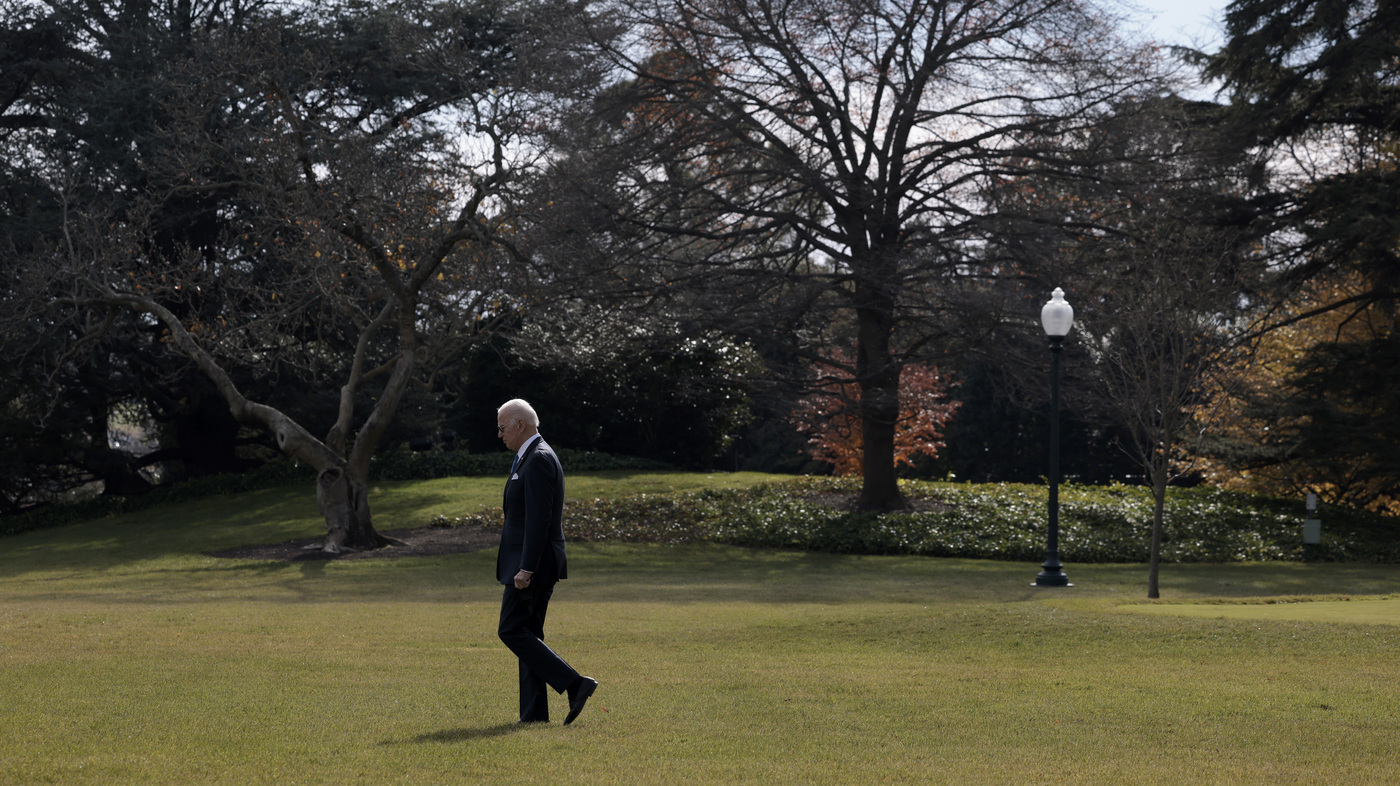
President Biden walks to Marine One outside the White House on Dec. 2.

Anna Moneymaker/Getty Images


hide caption

toggle caption

Anna Moneymaker/Getty Images


President Biden walks to Marine One outside the White House on Dec. 2.

Anna Moneymaker/Getty Images

When President-elect Joe Biden was asked whether student loan cancellation figured into his economic recovery plan, he declared, “It should be done immediately.”

“[Student debt is] holding people up,” Biden said on Nov. 16, 2020. “They’re in real trouble. They’re having to make choices between paying their student loan and paying the rent.”

On the campaign trail, Biden had pledged to cancel at least $10,000 of student debt per person.

One year later, while Biden has provided hundreds of thousands of borrowers with debt relief, that $10,000 promise remains unfulfilled. Here’s a look at why — and what he has done.

Biden has focused on preexisting forgiveness programs

The Biden administration’s approach to student loan relief began with improving, extending or expanding a handful of programs that were already on the books.

“We’re working really hard to get students the relief that they’re entitled to” through these preexisting programs, Undersecretary of Education James Kvaal told NPR on Friday.

While it’s not loan forgiveness, Biden extended the pandemic pause on federal student loan payments; that pause is now slated to lift in February. His other actions essentially keep promises the U.S. government had already made to borrowers — rather than make new ones. For example:

  • Total and permanent disability discharge: In August, Education Secretary Miguel Cardona announced that the department would erase the federal student debts of thousands of borrowers with permanent disabilities. A 2019 NPR investigation found that, even though eligible borrowers have been legally entitled to a full discharge of their loans, the process was so complicated that fewer than half were able to shed their debts. The latest data from the Education Department suggests that these changes will help at least 370,000 borrowers drop more than $6.5 billion in student debts.
  • Borrower defense and closed-school discharge: The Biden administration has dramatically expanded efforts to help students who have been defrauded by for-profit colleges and/or whose schools have been forced to close. Defrauded students who previously filed “borrower defense” claims but were given only partial relief under Trump administration rules will now see the rest of their federal student loans discharged.
  • Public Service Loan Forgiveness (PSLF): The program meant to forgive borrowers’ debts after 10 years of public service and steady loan payments has been notoriously stingy, with complex rules and serial mismanagement pushing out many eligible borrowers. In October, though, the department used its expanded pandemic authority to retroactively loosen those rules and give borrowers credit for disqualified loan payments. According to the department, the overhaul has already forgiven $2 billion in debts.

Through these efforts, the Education Department says it has discharged or is in the process of discharging roughly $12.7 billion in student debt, affecting more than 638,000 borrowers.

While these moves were cheered by borrowers and advocates, they were not without controversy. The top Republican on the House Education Committee, Rep. Virginia Foxx of North Carolina, decried the department’s PSLF waiver, calling it “an abuse of executive authority” and “too significant of an issue” to act without Congress.

Broader loan forgiveness would be even more controversial.

In February, Sen. John Thune, R-S.D., responded to some Democrats’ demand that Biden forgive as much as $50,000 in student debt per borrower by calling it “incredibly, fundamentally unfair” to students who have already repaid their debts.

Foxx agrees, telling NPR that borrowers have a responsibility to repay their student debts: “It’s no different than having taken out a loan for a car that you then find you can’t pay back or taking out a loan for a home that you can no longer pay for — or you choose not to pay for.”

Many critics of broad loan forgiveness agree that the cost of college is out of control but insist that canceling student debts would simply address a symptom of the problem, not its cause.

“In fact, Democrats’ ‘solution’ is likely to make things worse,” Thune said on the Senate floor.

“What incentive will colleges have to restrain tuition growth if they think they can rely on the federal government to subsidize their students’ tuition fees through loan forgiveness?”

Advocates and borrowers aren’t satisfied with Biden’s actions so far

While many Republicans have resisted calls for debt cancellation, many Democrats and advocates for student loan relief are growing restless. To them, Biden’s $12.7 billion in debt relief so far is a rounding error, considering that nearly 46 million Americans have $1.6 trillion in federal student loans. And he campaigned on doing more — again, $10,000 per borrower.

“That was a pretty clear promise that he made during the campaign,” says Persis Yu, policy director at the Student Borrower Protection Center. “And certainly, that is a promise that I think many borrowers are right now waiting for him to fulfill.”

Yu also says keeping that promise would make a huge difference, especially for borrowers already in default. “Roughly 16 million borrowers would have their entire debts extinguished, and that amounts to roughly two-thirds of the borrowers who are in default.”

“Crumbs’ worth of action.” That’s how Jalil Mustaffa Bishop describes the Biden administration’s efforts thus far. The assistant professor at Villanova University studies inequities in higher education.

In June, borrower advocates erected signs in front of the White House calling on President Biden to cancel student debt.

Paul Morigi/Getty Images


hide caption

toggle caption

Paul Morigi/Getty Images

Mustaffa Bishop says the student loan system badly needs an overhaul, especially “for groups that historically have been marginalized and had to experience generations of different types of debt traps,” from sharecropping to subprime mortgages to payday lending. Student loans are no different.

Mustaffa Bishop co-authored a recent survey of nearly 1,300 Black borrowers. The report, “Jim Crow Debt,” produced in partnership with the Education Trust, unpacks how pervasive racial inequities, including widespread wealth disparities and persistent workplace discrimination, have left many people of color drowning in student debt.

A 2019 report from the Institute on Assets and Social Policy at Brandeis University found that “Twenty years after starting college, the median debt of White borrowing students has been reduced by 94 percent — with almost half holding no student debt — whereas Black borrowers at the median still owe 95 percent of their cumulative borrowing total.”

Two-thirds of respondents to Mustaffa Bishop’s survey said, in hindsight, they regretted having taken out student loans.

“The student debt crisis is a racial and economic justice issue and we must finally begin to address it as such,” said Rep. Ayanna Pressley, D-Mass., in a statement roughly one year ago. “Broad-based student debt cancellation is precisely the kind of bold, high-impact policy that the broad and diverse coalition that elected Joe Biden and Kamala Harris expect them to deliver.”

There are two ways to cancel student loans

To understand why Biden hasn’t pushed for broad student loan forgiveness, it helps to understand how he could, using one of two doors: 1) Congress or 2) executive action.

Door No. 1 is less controversial, to be sure, but keying it open requires bipartisan support or, at least, unwavering support from Democrats. Loan cancellation appears to have neither.

Consider this: Among the proposals that have been dropped from Biden’s Build Back Better agenda is his pitch for free community college. It’s hard to imagine Democrats would abandon that, at a cost of roughly $45 billion, but still support spending at least $370 billion on student loan forgiveness.

So this door is likely locked — and maybe boarded up from the inside.

That leaves Door No. 2.

Much has been written about the president’s authority — through his education secretary — to simply cancel the debts of millions of borrowers. Here’s an NPR primer from nearly two years ago.

But Biden doesn’t seem eager to try this door. For one thing, he says, it’s not certain that canceling student loans with the stroke of his pen would hold up in court, admitting in a February 2021 town hall that “I don’t think I have the authority” to cancel $50,000 per borrower.

And Biden is not alone in his skepticism.

“The president can’t do it,” said House Speaker Nancy Pelosi, D-Calif., speaking to the media in July. “That’s not even a discussion.”

Whether Pelosi’s conclusion was driven by facts or political expediency (read: giving Biden cover for not keeping a campaign promise), Biden has resisted acting unilaterally.

There’s also the matter of cost. Again, forgiving $10,000 per borrower would come with about a $370 billion price tag, according to the Brookings Institution. Forgiving $50,000 per borrower could cost about $1 trillion.

“Why should taxpayers — 70{ac23b82de22bd478cde2a3afa9e55fd5f696f5668b46466ac4c8be2ee1b69550} of whom didn’t go to college — pay back loans for people who have an obligation they haven’t fulfilled?” Foxx asks. (In 2020, the U.S. Census Bureau reported that “From 2010 to 2019, the percentage of people age 25 and older with a bachelor’s degree or higher jumped from 29.9{ac23b82de22bd478cde2a3afa9e55fd5f696f5668b46466ac4c8be2ee1b69550} to 36.0{ac23b82de22bd478cde2a3afa9e55fd5f696f5668b46466ac4c8be2ee1b69550}.”)

Foxx thinks this popularity question is a big reason behind Biden’s hesitancy to act.

“I do think the president maybe understands that broad loan forgiveness is not popular in this country, which is why, I think, he has not gone the route of doing what some in his party want to do.”

But polling suggests broad loan forgiveness would be popular, if done with some nuance. For example, a Grinnell College poll conducted in March found that 27{ac23b82de22bd478cde2a3afa9e55fd5f696f5668b46466ac4c8be2ee1b69550} of respondents supported forgiving all student debt and an additional 39{ac23b82de22bd478cde2a3afa9e55fd5f696f5668b46466ac4c8be2ee1b69550} supported forgiveness “for those in need.” In other polling — from Vox/Data for Progress and the Harris Poll — a majority of respondents supported broad, if limited, forgiveness.

Instead of acting unilaterally, though, this year Biden asked the Education and Justice departments to explore his legal options. The results are still TBD, more than six months later.

Since then, the White House has gone largely quiet on loan cancellation. Some advocates — and many Democrats — worry that, for whatever reason, the administration is intentionally dragging its feet. Not so, said Kvaal, the education undersecretary, in his interview with NPR.

“Legal authority is not an on-off switch. You need to think about the standards that would be applied, the rationale that we can muster,” Kvaal explained. “We are looking very carefully with the White House and the Department of Justice at whether we can cancel loans across the board for everyone, and that’s something where deliberations are still continuing.”

Time may be running out

There’s an argument to be made that Biden is running out of time to broadly cancel student debts. Democrats’ majorities in Congress are likely to shrink next year, if not melt into minorities.

What’s more, the Education Department has said it will require that federal student loan payments, paused during the pandemic, resume as early as Jan. 31.

Imagine millions of borrowers navigating a repayment system they haven’t used in more than a year and a half. Many will need to speak with their loan servicing company to change repayment options. And two of those companies, which serve roughly 15 million borrowers, are right now transitioning out of the federal student loan business all together.

NPR has spoken with more than a dozen student loan experts, including a handful inside the department, who all say they expect this return to repayment to be … difficult.

If broad-based student loan forgiveness is going to happen, it makes all the sense in the world to do it before Jan. 31. Biden’s campaign pledge would mean millions of borrowers would have their debts erased, allowing them to avoid this difficult, potentially disastrous payment restart.

That doesn’t mean Biden has to keep his $10,000 loan forgiveness pledge by then. It just means, if he doesn’t, it’s hard to imagine broad forgiveness happening anytime soon, if at all.

Live Updates: Today’s Business and Stock Market News

SAN JOSE, Calif. — For the six days that Elizabeth Holmes, the founder of the failed blood-testing start-up Theranos, took the stand in her fraud trial, she blamed others, accused a former boyfriend of abusing and controlling her, and reframed her actions as trying to do good for her company.

On Tuesday, Ms. Holmes capped her defense with flat denials.

“I don’t think I did that,” she said in response to a question about whether she had minimized the findings of a devastating regulatory inspection at Theranos. She then blamed her company’s lawyers for “doing a lot of the talking in that meeting.”

The comments ended Ms. Holmes’s main testimony, which stood out as the rarest of rarities. Few technology executives, let alone a female tech executive, are ever charged with criminal fraud. Even fewer take the stand to defend themselves. Her time on the stand, which is likely to formally finish on Wednesday, was the climax to a trial that has captivated the business world and been held up as a parable of Silicon Valley’s fake-it-till-you-make-it culture on overdrive.

Ms. Holmes, 37, has pleaded not guilty to 11 counts of fraud for claims she made as chief executive of Theranos, which she founded in 2003. If convicted, she faces up to 20 years in jail.

Her trial is now moving into its end stage. Either side may call final witnesses over the coming days, followed by closing arguments and detailed instructions to jurors for their deliberations on a verdict.

“The jury got to know her over six days,” Jeffrey Cohen, an associate professor at Boston College Law School, said of Ms. Holmes. “If the defense is successful, that might be the decision that will make the difference.”

For most of the proceedings, the jury heard witnesses testify about the details of Ms. Holmes’s alleged fraud. Theranos rose to prominence, raising $945 million in funding, by claiming that its revolutionary machines could perform hundreds of tests using only a tiny drop of blood. The hype made Ms. Holmes a fixture on magazine covers that hailed her as the next Steve Jobs.

But a 2015 expose in The Wall Street Journal exposed problems with Theranos’s blood tests, kicking off a downward spiral of regulatory crackdowns and lawsuits. The company dissolved in 2018, and Ms. Holmes was indicted.


Who’s Who in the Elizabeth Holmes Trial

Erin Woo

Erin Woo📍Reporting from San Jose, Calif.

Who’s Who in the Elizabeth Holmes Trial

Erin Woo

Erin Woo📍Reporting from San Jose, Calif.

Carlos Chavarria for The New York Times

Elizabeth Holmes, the disgraced founder of the blood testing start-up Theranos, stands trial for two counts of conspiracy to commit wire fraud and nine counts of wire fraud.

Here are some of the key figures in the case →

Item 1 of 9

Since her trial began in September, prosecutors have called dozens of witnesses, including former board members, lab directors, employees, investors, patients and business partners. They have revealed the details of falsified documents, outlandish financial projections, unrealistic promises and faked demonstrations at Theranos. Witnesses often spent hours on the tedious minutiae of finance, chemistry, technology and phlebotomy.

Much of the case against Ms. Holmes has relied on her emails and text messages to tie her directly to the company’s problems. Prosecutors must convince the jury that Ms. Holmes knew about the problems and failed to disclose them to the people pouring money into Theranos and to the patients relying on its blood tests to make medical decisions.

In her defense, Mr. Holmes’s lawyers tried showing that the witnesses’ stories were more complicated than they had let on. Defense lawyers hit investors for not doing enough research on Theranos before investing. And they tried blaming lab directors for problems with the accuracy of Theranos’s tests.

Through it all, Ms. Holmes sat up stick-straight in her chair and stared straight ahead, her expression obscured by a mask.

After prosecutors rested their case last month, and before calling Ms. Holmes to the stand, her lawyers introduced brief testimony from a biotechnology executive who joined Theranos’s board of directors after it came under fire from the media and regulators.

Ms. Holmes then offered a variety of excuses for Theranos’s shortcomings. She said others had misinterpreted her statements about what Theranos’s technology could do. She said that, until a 2015 regulatory inspection revealed a host of problems and forced Theranos to void its tests, she believed its tests worked. She said she hadn’t been qualified to run a lab and had relied on the statements of others.

She also admitted to adding the logos of pharmaceutical companies to a series of reports, which implied the drug makers had endorsed Theranos’s technology when they hadn’t. For this, she expressed regret.

Her direct testimony ended with a bombshell revelation that Ramesh Balwani, her former boyfriend, business partner and alleged co-conspirator, emotionally and physically abused her. Through tears, she testified that Mr. Balwani had controlled every aspect of her life — including her schedule, diet and presentation — and had even forced her to have sex with him against her will.

On cross-examination, she choked up again when prosecutors had her read text messages with Mr. Balwani that showed a more affectionate side of their relationship. Prosecutors elicited several more mea culpas from Ms. Holmes, including regret over how she handled the Journal exposé and a positive Fortune cover story about the company that was later heavily corrected.

This week, prosecutors homed in on the discrepancies between what Ms. Holmes said in her testimony and what investors said she had told them. Numerous Theranos partners and investors testified that they had believed the company had contracts with the military and deployed its technology in medevacs and on battlefields, for example.

One of the prosecutors, Robert Leach, an assistant U.S. attorney, asked Ms. Holmes different versions of the same question repeatedly to hammer the lack of military contracts. She confirmed that Theranos had not had the contracts.

To show that Theranos was never paid for work with the drug maker GlaxoSmithKline, Mr. Leach also repeatedly asked Ms. Holmes about the lack of revenue, posing the question for each year from 2007 to 2014. Ms. Holmes said no each time.

Ms. Holmes resisted many of Mr. Leach’s lines of questioning by testifying that she didn’t recall or didn’t know. She also tried to dispute details in certain questions.

Ms. Holmes’s lawyers questioned her for a second time Tuesday afternoon with a rapid-fire series of statements meant to undermine Mr. Leach’s points and reiterate her initial testimony. Once again, Ms. Holmes said that Mr. Balwani had created Theranos’s unrealistic financial projections and that Theranos’s scientists had put together reports on its technology.

Until a regulatory inspection revealed deeper problems, she testified, she thought Theranos’s lab was “excellent.” Ms. Holmes also repeatedly stressed her concerns over exposing Theranos’s trade secrets as an excuse for withholding information from investors and partners, testifying again that she worried the company would lose its ability to compete. Discussing Theranos’s use of third-party machines would have violated Theranos’s own trade-secret policy, she said.

Mr. Leach tried knocking down that argument by noting that most of Theranos’s investors and partners had signed nondisclosure agreements that Ms. Holmes expected to be followed.

He further noted that, despite Ms. Holmes’s holding a patent for some technology, a patent did not “necessarily mean the invention described in the patent works.” Mr. Leach asked her if she had created a pill that measures lipids in blood, as described in one Theranos patent.

Ms. Holmes smiled, leaned into the microphone and said, “Not yet.”

Erin Woo contributed reporting.

Starting your Nevada business: Open accounts with suppliers

Brad Scribner

NCET will help you explore company and know-how.

Preserving supplier relationships is essential to building and scaling your small small business. High-quality associations with your suppliers not only secure your offer chains and distribution but can also be vital sources of facts. No matter whether you are positioned as business-to-business or business-to-client, ensuring your suppliers are happy will make all areas of your business enterprise operate more easily.

For new organizations, finding suppliers on board can be a very simple make a difference of lessening their publicity to threat. Order dimensions, capacity to pay and your business’s measurement, popularity, seriousness and past associations are all variables that suppliers may perhaps take into thought just before jumping into an settlement. Of program, the for a longer time you are in company, the stronger your track record will be (ideally), but new small business owners may perhaps nonetheless have trouble in convincing a provider that they’re really serious. You can assistance to simplicity their worries by setting up a public-dealing with web page, remaining experienced about your field, and figuring out just what you are seeking for — no a person needs their time wasted, and almost nothing suggests “amateur small business owner” like becoming clueless about what your possible supplier presents.

It’s finest to think about suppliers in four standard categories:

► Brands: If you can, it’s most effective to go straight to the source. Producer rates will generally be lower than other styles of suppliers unless of course the geographic site of the supplier can make shipping and delivery expense prohibitive. Wholesale orders are the greatest way to retain costs low.

Amazon shopping, streaming, business services begin to come back after outage :: WRAL.com

— Holiday getaway purchasers and internet developers nationwide were being stalled on Tuesday when some of Amazon’s business providers, such as e-commerce, internet web hosting and Prime Video, went offline soon just after 10:30 a.m. ET, according to DownDetector.com, which tracks connectivity concerns centered on customer stories.

At midday, DownDetector confirmed a peak of a lot more than 25,000 studies of problems connecting to Amazon.com and 11,000 experiences about outages on Amazon Web Services, which presents remote computing and cloud computing products and services to other corporations, like WRAL Digital. The trouble was concentrated together the japanese seaboard, with Boston, New York, Washington, D.C., and Atlanta all displaying outages.

WRAL utilizes Amazon Web Services, for instance, to timetable the livestreaming of frequent newscasts to the WRAL Information application and to download the most current information stories from the Associated Press and video clip from NBC. Just about every of individuals services was demonstrating delays or was merely unavailable on Tuesday.

A test of AWS position showed that products and services named Amazon Join, Amazon DynamoDB and Amazon Elastic Compute Cloud, all primarily based in northern Virginia, had been demonstrating improved error prices and “degraded contact handling” all over the day.

Katharine Knowles stated she was buying on Amazon.com, hoping to beat the holiday procuring hurry by buying early, but when it was time to verify out, her payment would not go as a result of.

“It was not demonstrating my get as currently being acquired, and I was obtaining a minor anxious about that for the reason that we are on a time hold off, and we know all the offers these times are behind timetable,” Knowles reported.

Just prior to 6 p.m. ET, Amazon up-to-date business enterprise users, stating, “We are observing enhancement in availability.”

The organization said it expects most providers to progressively arrive back again on line by Tuesday night.

“These items do get fastened really quick. This is basically taking really prolonged,” explained Laurie Williams, Distinguished University Professor in the Personal computer Science Division of North Carolina State University’s School of Engineering.

Williams mentioned the outage seems to be simply a hardware problem, including that there is certainly no indicator of destructive action.

“You will find no problems becoming completed to the typical individual [but] a large amount of harm becoming completed to Netflix, Disney+ – they are not earning any income,” she explained. “You will find millions of dollars getting missing, in all probability, just about every moment.”

Knowles explained patience is essential to outlasting the outage.

“Eventually, I just restarted my telephone, paused on the order and hoped I hadn’t requested it two or 3 periods,” she claimed. “I guess we are going to find out when the outage is fastened.”