
USD 133.47 Billion Growth Expected in Smart Education Market: by Product (content, software, and hardware), End-user (higher education and K-12 schools), and Geography (APAC, Europe, North America, South America, and MEA)

NEW YORK, Dec. 9, 2021 /PRNewswire/ — Technavio has announced its latest market research report titled Smart Education Market by Product (Content, Software, and Hardware), End-user (higher education and K-12 schools), and Geography (APAC, Europe, North America, South America, and MEA).
Attractive Opportunities in Smart Education Market by Product, End-user, and Geography - Forecast and Analysis 2021-2025

Attractive Opportunities in Smart Education Market by Product, End-user, and Geography – Forecast and Analysis 2021-2025

Grab this latest smart education market report sample from Technavio Right Here!

Educational institutions are increasingly adopting advanced learning methodologies such as smart education to sharpen the employment prospects of students. The global workforce requirement scenario is facing issues of demand and supply gap, as graduate and post-graduate students lack industry-specific skills and hence, require training. As a result, institutions are focusing on imparting industry-related skills to students so that they can be competent as per industry requirements. The increased demand for education technology products can be attributed to the greater emphasis laid on STEM-based education. The demand for training and educating healthcare professionals in a smart education environment is rising due to the increasing demand for specialist healthcare workers such as physiotherapists and nurses. Hence, the scope for training and education of students opting for allied healthcare as their career is immense. As a result, the increasing employment opportunities will drive the growth of the smart education market.

Read the 120-page report with TOC on “Smart Education Market Analysis Report by Product (Content, Software, and Hardware), End-user (higher education and K-12 schools), and Geography (APAC, Europe, North America, South America, and MEA), and the Segment Forecasts,2021-2025″- https://www.technavio.com/report/report/smart-education-market-industry-analysis

The purchase, as well as the maintenance of these devices, takes a toll on the budgets allocated to schools. Institutions providing smart education are facing challenges related to adequate financial support. Although smart education offers several learning benefits, institutions need to take care of the procurement costs and hardware systems such as classroom wearables and projectors that are expensive. The hardware system procurement is also not uniform across countries, as emerging countries lack the required capital to install them. Educational institutions with limited budgets may not be able to invest heavily in the implementation as well as maintenance of smart software solutions such as LMS, thus, limiting the market growth. Such budget constraints will result in the slow adoption of smart education systems in emerging countries, particularly in the APAC and MEA.

Download Free sample Report for Actionable insights on the challenges that will help companies evaluate and develop growth strategies for 2021-2025.

Major Five Smart Education Companies:

  • Adobe Inc.

  • Blackboard Inc.

  • Cisco Systems Inc.

  • D2L Corp.

  • Dell Technologies Inc.

43{ac23b82de22bd478cde2a3afa9e55fd5f696f5668b46466ac4c8be2ee1b69550} of the market’s growth will originate from APAC during the forecast period. China and India are the key markets for smart education in APAC. Market growth in APAC will be faster than the growth of the market in other regions. The education industry in this region, especially India, Japan, and China, is evolving rapidly with regard to the adoption of advanced educational tools and technologies. This will facilitate the smart education market growth in APAC over the forecast period.

Subscribe to our “Lite Plan” billed annually at USD 3000 that enables you to download 3 reports a year and view 3 reports every month.

Smart Education Market Product Outlook (Revenue, USD bn, 2020-2025)

  • Content – size and forecast 2020-2025

  • Software – size and forecast 2020-2025

  • Hardware – size and forecast 2020-2025

Smart Education Market End-user Outlook (Revenue, USD bn, 2020-2025)

Smart Education Market Geography Outlook (Revenue, USD bn, 2020-2025)

  • APAC – size and forecast 2020-2025

  • Europe – size and forecast 2020-2025

  • North America – size and forecast 2020-2025

  • South America – size and forecast 2020-2025

  • MEA – size and forecast 2020-2025

Download this Smart Education Market report to uncover new strategies to make the most of future growth opportunities.

Related Reports on Consumer Discretionary Include:

Education Apps Market by End-user and Geography – Forecast and Analysis 2021-2025

Community College Market in US by Revenue Stream and Course Offerings – Forecast and Analysis 2021-2025

Smart Education Market Scope

Report Coverage

Details

Page number

120

Base year

2020

Forecast period

2021-2025

Growth momentum & CAGR

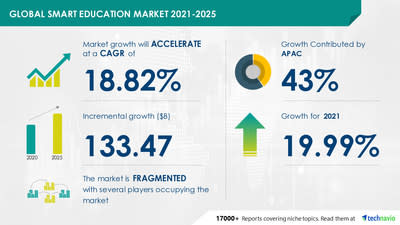
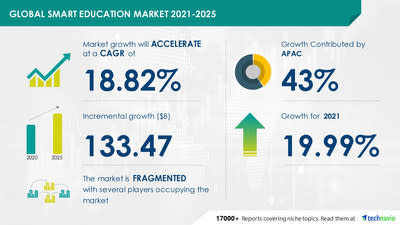
Accelerate at a CAGR of 18.82{ac23b82de22bd478cde2a3afa9e55fd5f696f5668b46466ac4c8be2ee1b69550}

Market growth 2021-2025

$ 133.47 billion

Market structure

Fragmented

YoY growth ({ac23b82de22bd478cde2a3afa9e55fd5f696f5668b46466ac4c8be2ee1b69550})

19.99

Regional analysis

APAC, Europe, North America, South America, and MEA

Performing market contribution

APAC at 43{ac23b82de22bd478cde2a3afa9e55fd5f696f5668b46466ac4c8be2ee1b69550}

Key consumer countries

US, UK, Germany, China, and India

Competitive landscape

Leading companies, competitive strategies, consumer engagement scope

Companies profiled

Adobe Inc., Blackboard Inc., Cisco Systems Inc., D2L Corp., Dell Technologies Inc., Discovery Education Inc., Ellucian Co. LP, Instructure Inc., Pearson Plc, and Samsung Electronics Co. Ltd.

Market Dynamics

Parent market analysis, Market growth inducers and obstacles, Fast-growing and slow-growing segment analysis, COVID-19 impact and future consumer dynamics, market condition analysis for the forecast period

Customization purview

If our report has not included the data that you are looking for, you can reach out to our analysts and get segments customized.

About Technavio

Technavio is a leading global technology research and advisory company. Their research and analysis focuses on emerging market trends and provides actionable insights to help businesses identify market opportunities and develop effective strategies to optimize their market positions.

With over 500 specialized analysts, Technavio’s report library consists of more than 17,000 reports and counting, covering 800 technologies, spanning across 50 countries. Their client base consists of enterprises of all sizes, including more than 100 Fortune 500 companies. This growing client base relies on Technavio’s comprehensive coverage, extensive research, and actionable market insights to identify opportunities in existing and potential markets and assess their competitive positions within changing market scenarios.

Contacts

Technavio Research
Jesse Maida
Media & Marketing Executive
US: +1 844 364 1100
UK: +44 203 893 3200
Email: media@technavio.com
Website: www.technavio.com/

Technavio (PRNewsfoto/Technavio)

Technavio (PRNewsfoto/Technavio)

Cision

Cision

View original content to download multimedia:https://www.prnewswire.com/news-releases/usd-133-47-billion-growth-expected-in-smart-education-market-by-product-content-software-and-hardware-end-user-higher-education-and-k-12-schools-and-geography-apac-europe-north-america-south-america-and-mea—global-301440291.html

SOURCE Technavio

Borrowers learn student loans could be forgiven earlier than expected : NPR

Zahra Nealy (left) and Victoria Chamberlin both stand to benefit from recent changes to the Public Service Loan Forgiveness program.

Roxanne Turpen and Amanda Andrade-Rhoades for NPR


hide caption

toggle caption

Roxanne Turpen and Amanda Andrade-Rhoades for NPR


Zahra Nealy (left) and Victoria Chamberlin both stand to benefit from recent changes to the Public Service Loan Forgiveness program.

Roxanne Turpen and Amanda Andrade-Rhoades for NPR

The U.S. Department of Education has begun sending emails to thousands of teachers, nurses and other public servants to tell them they could have some of their federal student loan debts erased months — and even years — earlier than borrowers had expected.

Education Secretary Miguel Cardona highlighted the move Friday night on Twitter: “Our first batch of PSLF emails regarding loan forgiveness have all gone out to those with Direct Consolidation Loans and certified employment – check your inboxes! And if you didn’t get one, hang tight! More are on the way.”

The flood of emails comes after the department announced it would overhaul the troubled Public Service Loan Forgiveness (PSLF) program, including giving borrowers a retroactive waiver from some of its toughest rules. As a result, the department estimates it could erase the student loan debts of nearly 50,000 public service workers and help half a million more get closer to the loan forgiveness they were promised.

Some borrowers who have received emails and have been told they’ll be getting additional credit toward loan forgiveness have taken to social media to celebrate.

When Victoria Chamberlin heard the news, it hit her: This could mean the end of her $70,000 in student loan debt. The U.S. Army veteran says she and her husband were cautiously elated.

“By the time our baby is 3,” Chamberlin says, “both of us will be student loan debt free. And that’s just unbelievable. We never thought it would be possible.”

Zahra Nealy says she was listening to NPR one morning when she heard the news about the waiver that would likely help her too.

“I was so excited when I heard [it] in the shower — made sure I didn’t slip!”

Years of mismanagement created a nightmare for borrowers

To appreciate the excitement — and relief — of thousands of public service borrowers, you have to understand how a program that was meant to do so much good ended up causing so much pain.

The Public Service Loan Forgiveness program began in 2007 to encourage borrowers to work in public service. But the rules were strict and badly communicated by the Education Department to the companies that manage student loans. Those companies then spent years mismanaging the program and misinforming borrowers.

Victoria Chamberlin served in the U.S. Army for several years. Now, new changes to the Public Service Loan Forgiveness program should help erase her $70,000 in student debts, which, she says, would be “unbelievable. We never thought it would be possible.”

Amanda Andrade-Rhoades for NPR


hide caption

toggle caption

Amanda Andrade-Rhoades for NPR


Victoria Chamberlin served in the U.S. Army for several years. Now, new changes to the Public Service Loan Forgiveness program should help erase her $70,000 in student debts, which, she says, would be “unbelievable. We never thought it would be possible.”

Amanda Andrade-Rhoades for NPR

“I don’t have a heartbreaking case where I was in the wrong repayment plan or my payment was off by a penny. I did everything exactly right,” says Chamberlin, who nevertheless ran afoul of the program after she and her husband enlisted in the Army.

Several times, when the couple attempted to recertify their incomes, as the program regularly requires, Chamberlin says the company managing their loans erroneously increased their monthly payments.

“And then we would have to go into forbearance while they figured it out,” Chamberlin remembers, “because we were both active duty and couldn’t afford [the higher payments].”

This constant back-and-forth — getting the payments corrected, then restarted — was exhausting, Chamberlin says, especially having to do it from military bases in Germany and South Korea.

“I’d have to go to the base and use the secure phone that you can call the States with but that you’re not supposed to use for personal reasons,” Chamberlin remembers. “It’s just been awful.”

The new waivers could transform borrowers’ financial futures

These stories of PSLF mistakes are legion — and a big reason the Education Department is giving borrowers retroactive waivers from some of the program’s toughest rules.

Borrowers who were disqualified for being in the wrong repayment plan, for example, or for having the wrong kind of loan can now get credit for past payments. In fact, in an email on Friday, the department notified Chamberlin that she should get credit for at least 11 months she spent paying down the wrong kind of loan. According to the details of the overhaul, she should also get credit for the months her payments were paused while she was on active duty.

Chamberlin now works for a private company, but she says she served more than enough time to qualify for forgiveness. “It sounds dramatic, but if my loans can actually get forgiven, then I won’t have to leave the job that I really like.”

Zahra Nealy is nine months from having half her student loan debts erased under the Public Service Loan Forgiveness program. Now, because of changes to the program, she could be completely free of student debt within a year.

Roxanne Turpen for NPR


hide caption

toggle caption

Roxanne Turpen for NPR


Zahra Nealy is nine months from having half her student loan debts erased under the Public Service Loan Forgiveness program. Now, because of changes to the program, she could be completely free of student debt within a year.

Roxanne Turpen for NPR

Zahra Nealy has spent nearly a decade working for nonprofits in Southern California, and like Chamberlin, she also had a paperwork problem. But she is now back on track.

“I am nine payments away from being eligible for loan forgiveness,” says Nealy. That means she has made 111 eligible on-time payments and is now less than a year away from having some of her student debts erased. Some, because she has always had two kinds of loans. Half her debts qualify for PSLF; half don’t. Roughly $140,000 in all.

But after the Education Department announced it was loosening its rules, Nealy learned that potentially all her loans could be eligible for forgiveness and could be erased within a year. “Which would be huge!” Nealy says, laughing with excitement.

She says that because of her debts, homeownership has felt unattainable. But soon, maybe not.

And this news has her feeling something she’s not used to feeling about her student debts: “Hope,” Nealy says. “It’s really hope. In a desperate time.”